


How Long Does a Shower Filter Take to Work?
Water feels gentler from the first shower, skin settles in 2–4 weeks, hair takes 6–12 weeks. The honest timeline for UAE water, and how to test it.

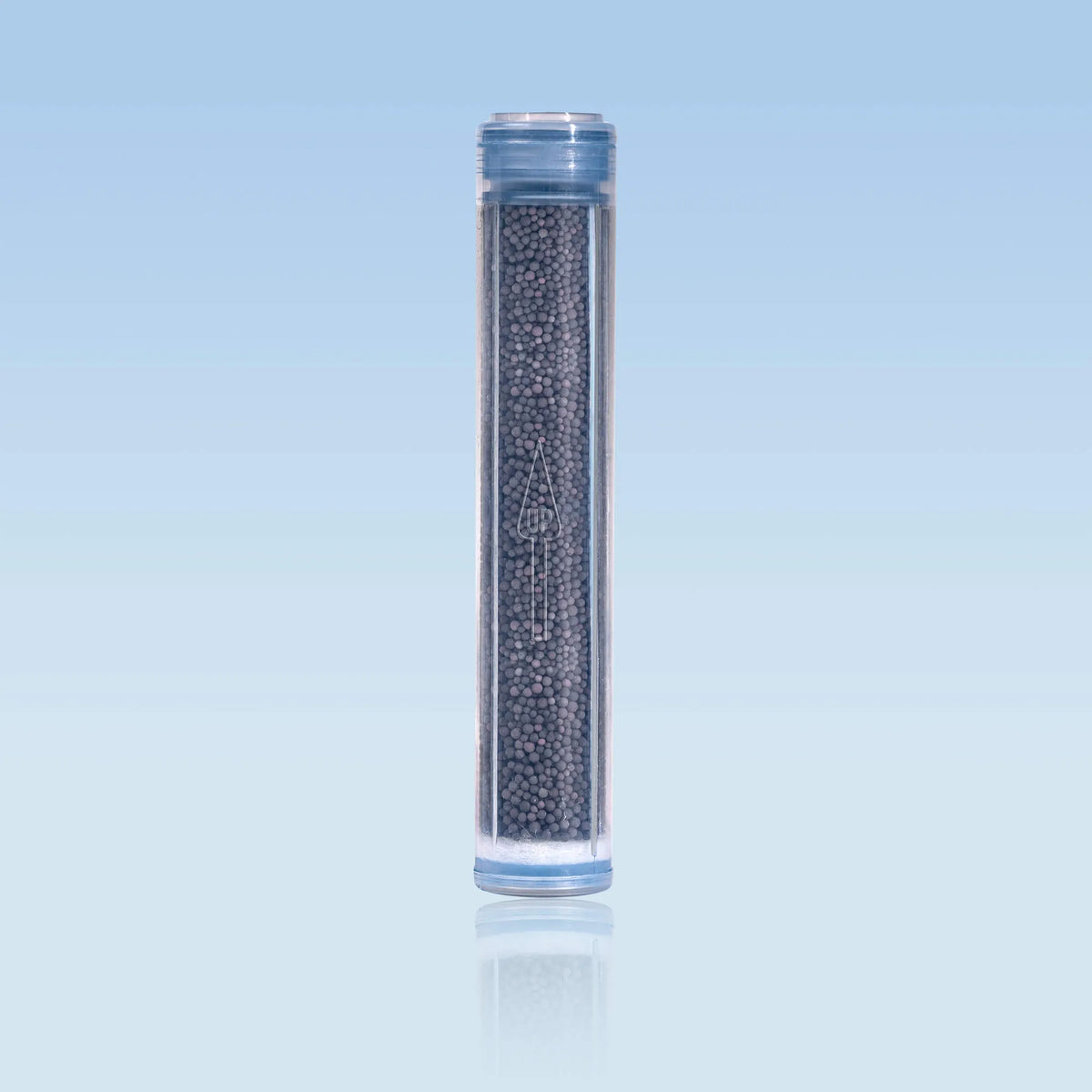
blu NMC filter cartridge shown fresh with slate-blue beads beside one browned after two months of use
A shower filter works on three different clocks, and knowing which one you are on is the difference between judging it fairly and giving up too early.
The water changes on the first shower. Skin and scalp usually settle over two to four weeks. Hair is slowest by a wide margin — six to twelve weeks — and not because of the filter. Here is the honest timeline, why each stage takes as long as it does, and how to check you are on track before you can see anything.
- Shower 1: less chlorine smell, gentler-feeling water. Chemistry, not adaptation.
- Weeks 2–4: skin and scalp. Roughly one epidermal turnover cycle, about 45 to 48 days end to end.
- Weeks 6–12: hair. It grows about a centimetre a month, and hair already resting sheds on schedule whatever you change today.
- At two weeks, check the cartridge, not your hair. A slate-blue medium darkening toward brown records what it captured.
- A filter is a water-quality change. It does not regrow hair, soften water, or treat a skin condition.
The timeline at a glance
Three things change on three separate schedules, and none of them is set by the filter.
| What changes | When | What sets the pace |
|---|---|---|
| The water: smell, feel, less chlorine | Shower 1 | Nothing — it is immediate |
| Skin and scalp: less tightness and flaking | Weeks 2–4 | Epidermal turnover, roughly 45–48 days |
| Hair breakage: less snagging and snapping | Weeks 4–8 | How fast undamaged hair replaces damaged hair |
| Hair shedding | Weeks 8–12+ | The hair cycle: telogen lasts about four months |
| Hardness, limescale, calcium | Never | A filter is not a softener |
From the first shower: the water itself
The fastest change is not in you — it is in what comes out of the shower head, and you notice it the first time you use it.
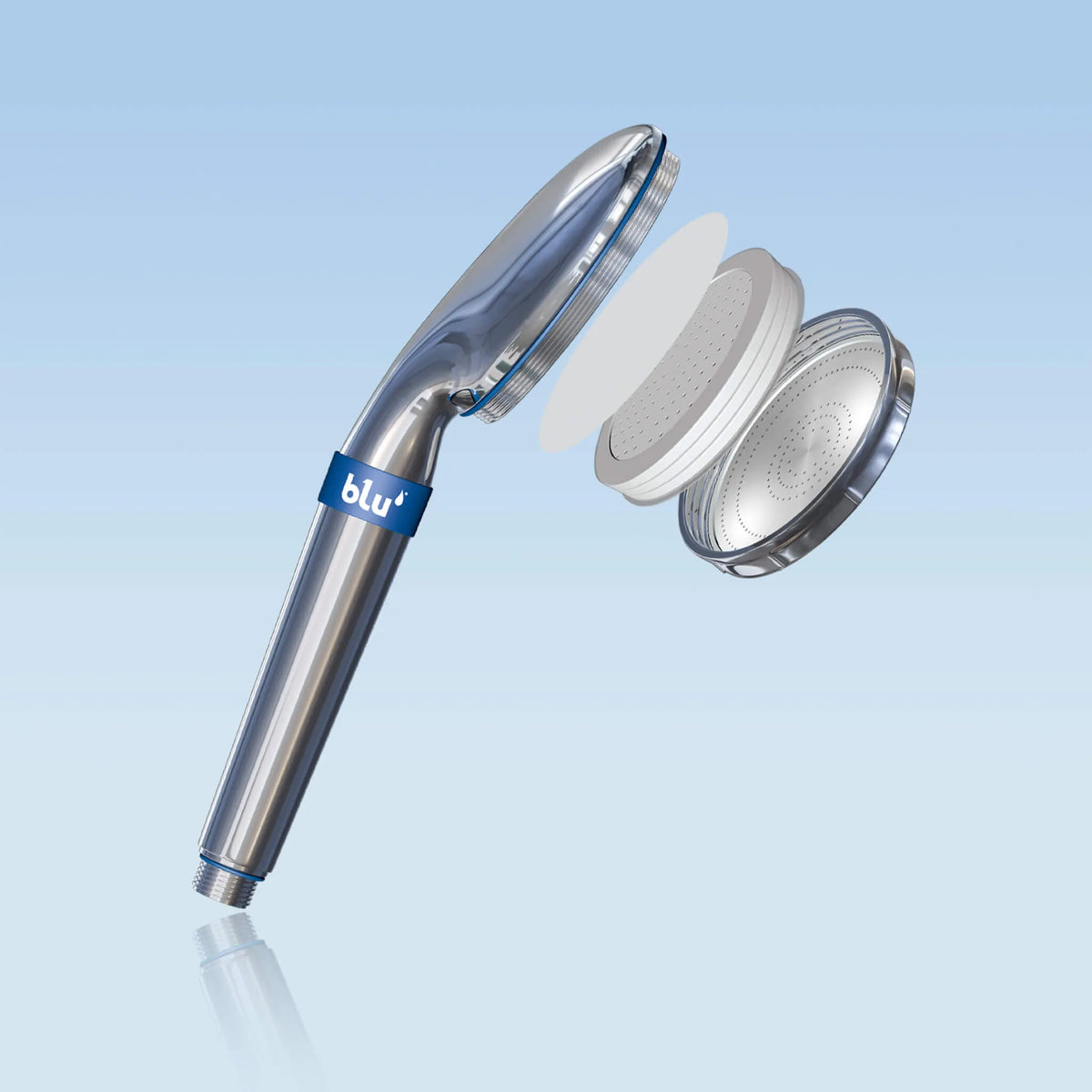
Chlorine has a smell and a feel, and when it is reduced the water reads as gentler straight away. blu's Ionic Shower Head & Filter is built on an NSF/ANSI 42 certified filtration medium — the standard covering chlorine, taste and odour — and reduces chlorine, heavy metal ions, dirt and odours in the water passing through it. In independent testing by Eurofins (report EFSN24031276, April 2024), free chlorine fell from 17.09 mg/L to 0.09 mg/L, a 99.5% reduction. Gulf News named it Best Overall in its March 2024 UAE roundup.
One honest caveat, because it sets expectations correctly: no shower filter softens water. Carbon and NMC media do not reduce the calcium and magnesium that make UAE water hard, so hardness and limescale are unchanged. Water can feel softer without being chemically softened — that is the chlorine leaving, not the minerals. Reducing hardness needs ion exchange, which is what blu's separate NXT LVL Shower Softener & Filter uses. More on what UAE water carries: Why Dubai's water is so hard on your hair and skin.
Weeks 2–4: skin and scalp
Skin is the middle clock, and the wait is a turnover cycle, not a marketing number.
Once the daily chlorine exposure drops, your barrier stops being stripped every evening. But the skin you are standing in was built before you fitted anything, and it has to be replaced before it feels different. That runs on a fixed schedule: measurements of epidermal turnover time put full renewal at roughly 45 to 48 days, with the stratum corneum layer turning over in about 14 to 20 days in young adults. Two to four weeks is about one pass through the outer layers.
What you are looking for is less tightness ten minutes after towelling off, less itch, less flaking — not a transformation. In blu's own voluntary, incentivized survey of 2,380 verified customers (May and July 2026, self-reported, not clinical), 64% reported at least one hair, skin, dryness, freshness or vitality benefit. That is perception, not measurement, and it is reported as such on The Results.
Weeks 6–12: hair, and why it is slowest
Hair responds to two different things on two different clocks, and confusing them is why people give up at day fourteen.
Breakage improves sooner
Breakage is mechanical. Chlorine oxidises and roughens the cuticle; roughened hair snags, tangles and snaps mid-strand. Take chlorine out of the daily wash and the strands you already have stop taking that beating. Less tangling and fewer short broken pieces in the brush can show up inside the first month or two — before any change in shedding.
Shedding lags by months, and not because of the filter
Shedding runs on a timer that was set before you bought anything. Each follicle grows for about four years, then rests for about four months before releasing the hair. Losing up to around 100 hairs a day is simply that cycle working.
The consequence matters: a hair that entered its resting phase two months ago will fall out on schedule no matter what your water is like now. DermNet puts the interval between a trigger and the increase in shedding at two to four months, matching the length of the resting phase. Change the water today and you influence the hair that grows next, not the hair already queued to fall.
Add a growth rate of roughly one centimetre a month — about 0.35 mm a day — and six to twelve weeks is the minimum honest answer. At week four, healthier new growth is a centimetre long and buried in the rest of your hair; at week twelve it is three centimetres and starting to be visible.
And one thing a filter cannot do, stated plainly: it does not regrow hair. If your hair loss is genetic or hormonal, or driven by iron, thyroid or a recent illness, water was never the main factor — see a doctor rather than waiting on a shower head.
The two-week checkpoint: look at the cartridge
Two weeks is when most people decide whether a filter is working, and it is the one point where your hair genuinely cannot tell you yet. So check something that can.
Turn off the water, unscrew the housing and look at the NMC cartridge. It starts slate-blue and darkens toward brown as the medium loads up. That colour is not dye — it is the redox reactions consuming the active surface, and it is how blu tells you a cartridge is spent. How far along it is at week two depends on your building: a villa on a new line and a flat fed by a hot rooftop tank will not look the same. Any shift toward brown is a physical record of what did not reach your hair. A blu cartridge is rated for roughly 70 to 100 showers, about two months of normal use.
How to give it a fair test
- Day 0. Photograph your hairline and part in the same light. Note how your skin feels ten minutes after a shower.
- Shower 1. Judge the water only — smell and feel.
- Week 2. Check the cartridge, not your hair.
- Week 4. Re-check skin and scalp. Look for less breakage and tangling, not less shedding.
- Weeks 8–12. Now judge hair, against your day-0 photos.
Four things stretch the timeline or stop it working. A cartridge past its service life or badly seated — reseat or replace it first. Only one shower filtered, so gym and second-bathroom showers keep the exposure going. Inconsistent use, because the benefit is cumulative in the way the damage was. And, most often, a cause that was never the water: genetic or hormonal hair loss, thyroid or iron problems, postpartum shedding and diagnosed skin conditions all need medical attention. Hard, chlorinated water can make hair and skin problems worse; it is not always what caused them.
One calendar note: blu's 30-day money-back guarantee runs from your purchase date, so it closes inside the skin window, well before the hair window does. If hair is what you are waiting on when it ends, you are about a third of the way through a twelve-week question.
Frequently asked questions
How long does a shower filter take to work?
The water changes on the first shower. Skin and scalp typically settle over two to four weeks. Hair takes longest: six to twelve weeks of consistent daily use, because it grows about a centimetre a month and hair already in its resting phase sheds regardless.
Is two weeks long enough to tell if a shower filter is working?
For the water, and often for skin, yes. For hair, no. At two weeks the fair thing to check is the cartridge: if it has begun darkening toward brown, it is capturing contaminants whatever your hair is doing.
How long before a shower filter helps with hair fall?
Allow six to twelve weeks, and judge breakage before shedding. Shedding lags any change by two to four months, the length of the resting phase. A filter takes a water-quality factor out of the picture; it does not regrow hair, and persistent hair loss should be seen by a doctor.
Will the water feel softer straight away?
Many people say it feels gentler from the first shower, but that is the chlorine reduction, not softening. The hardness is unchanged, because no shower filter reduces calcium or magnesium. If it is hardness itself you want addressed, that needs ion exchange — blu's separate NXT LVL Shower Softener & Filter.
How do I know it is working before I can see results?
Three checks that do not depend on time: the chlorine smell drops from the first shower; the cartridge visibly darkens as it loads; and the certification tells you what the medium is verified to do — blu's is an NSF/ANSI 42 certified filtration medium.
What if nothing has changed by the end of the 30-day guarantee?
Check the cartridge is fresh and correctly seated and that every shower you use is filtered. blu's 30-day money-back guarantee is no-questions-asked and runs 30 days from your purchase date, so if you want to return the filter, ask before then. If the water and your skin have improved and hair is what you are waiting on, that is the expected pattern rather than a failure.
Sources
- DermNet — Telogen effluvium: anagen about four years, telogen about four months, shedding increases two to four months after a trigger, up to about 100 hairs a day is normal.
- StatPearls — Anatomy, Hair: scalp hair grows at roughly 0.35 mm a day.
- Iizuka, Epidermal turnover time, J Dermatol Sci, 1994 — full turnover calculated at 45–48 days.
- Gulf News, March 2024 — 5 best shower filters in the UAE.
- blu, The Results — the 2,380-customer survey with its full methodology and limitations.
- Eurofins, report EFSN24031276, April 2024 — free chlorine reduction test of the blu NMC cartridge, 17.09 mg/L to 0.09 mg/L.
General information about water quality, not medical advice. If you are experiencing significant hair loss or a persistent skin condition, please see a doctor.




Leave a comment