


Hard Water and Curly Hair: What It Actually Does
Hard water coats curls in calcium and magnesium; chlorine roughens the cuticle. What the research shows, what a filter can and cannot fix, and a UAE routine.

Woman with curly hair unboxing the blu Ionic Shower Filter handheld
If your curls behaved back home and stopped behaving here, the water is a reasonable place to look — but the popular version of the story is wrong in a way that makes people buy the wrong thing.
Hard water does not strip your curls. It adds to them: a thin mineral film that builds wash after wash, dulls definition and sabotages every product you put on afterwards. Chlorine does the opposite job, on the fibre itself. Two problems, two fixes — and only one is solvable at the shower head.
- Hair washed in hard water carries measurably more minerals: mean calcium deposition of 0.804% versus 0.26% for distilled water, and magnesium 0.34% versus 0.078%.
- Whether that weakens hair is genuinely contested. One study found no loss of tensile strength; a later one, using harder water, found a significant loss.
- Curly fibres are elliptical and twisted, and crack at the twist points — so roughness and hard detangling cost more breakage.
- Hard water binds the surfactants in shampoo and leaves them on the surface. That is why the same products behave differently here.
- No shower filter softens water. A certified filter reduces chlorine and heavy metal ions; the mineral half needs chelating washes or ion exchange.
Why curls are the hair type hard water hits hardest
Curly hair is not straight hair with bends in it — it is structurally different in two ways that both matter here.
The shape makes it fragile
A straight fibre is roughly circular in cross-section. A curly one is flattened into an ellipse, and micro-CT imaging across the curl range confirms those ellipsoidal cross-sections and the way they twist along the strand. Twists are stress concentrators. Research on breakage in curly hair in the British Journal of Dermatology tracked crack propagation under controlled stress and found fractures initiating at flaws in the fibre, with combing generating the shear that drives cracks between cortical cells and between cuticle and cortex. The same paper cites a survey in which 96% of African-American respondents reported breakage.
So a curly fibre has more built-in weak points, and anything that roughens the surface or makes detangling harder costs more breakage than on straight hair.
The shape makes it drier
The cuticle cannot lie as flat around a tight bend as along a straight shaft, so a curly fibre presents a less sealed surface — more places for deposits to catch, more routes for moisture to leave. Sebum also travels down a coiled fibre far less readily. Curls start drier before water quality enters the picture, which is why they show it first.
What hard water actually deposits
Mineral deposition is the well-established part, and it has been measured directly.
Researchers washed matched hair samples in hard water (212.5 ppm as calcium carbonate) and in distilled water on alternate days for 30 days, then examined them under a scanning electron microscope. Mean calcium deposition was 0.804% on the hard-water hair against 0.26%; magnesium was 0.34% against 0.078%. Roughly three times the calcium and four times the magnesium, from identical washes. The hard-water samples also looked ruffled and measured thinner: 72.78 µm against 78.14 µm.
That film is what you feel as roughness, see as dullness and fight as lost definition. Coated strands do not clump the way clean ones do, and the extra weight and friction drag the pattern out. Separate work on hair mechanics found hardness metals concentrating in the cuticle layers and stiffening the fibre.
Now the honest part. An earlier study by the same lead author ran the same protocol and found no statistically significant difference in tensile strength or elasticity; its stated conclusion is that water hardness does not interfere with either. A 2018 study using water from the hardest of ten sampled districts did find a significant strength reduction. The fair summary: minerals demonstrably build up, and whether that measurably weakens the fibre depends on how hard the water is and how long the exposure runs. Here it is daily and indefinite.
The lather problem: why your products stopped working
This is the effect curly routines feel most, and it is straightforward chemistry: calcium and magnesium bind the surfactants in shampoo, so less is free to lather — and what binds does not rinse away.
Danby and colleagues at Sheffield showed this on skin, washing 80 participants with sodium lauryl sulfate in water of varying hardness. Sites washed with hard water carried significantly more surfactant deposits; those deposits raised transepidermal water loss and caused irritation, and softening by ion exchange mitigated it.
So you use more product for the same lather, more of it stays behind, and your conditioner has to work through a mineral-and-surfactant film before it reaches the hair. That is why a routine that worked perfectly elsewhere can feel broken here with identical products.
What chlorine adds on top
UAE tap water is chlorinated on purpose, and correctly so — a residual keeps the supply safe from the treatment plant to your tap.
For hair it is less friendly. Chlorine is an oxidising agent: it strips the sebum that keeps a curly fibre pliable, and it roughens the cuticle. A hot shower amplifies both, and unlike a pool this happens every day. The full picture is in Why Dubai's water is so hard on your hair and skin.
What a shower filter does — and does not
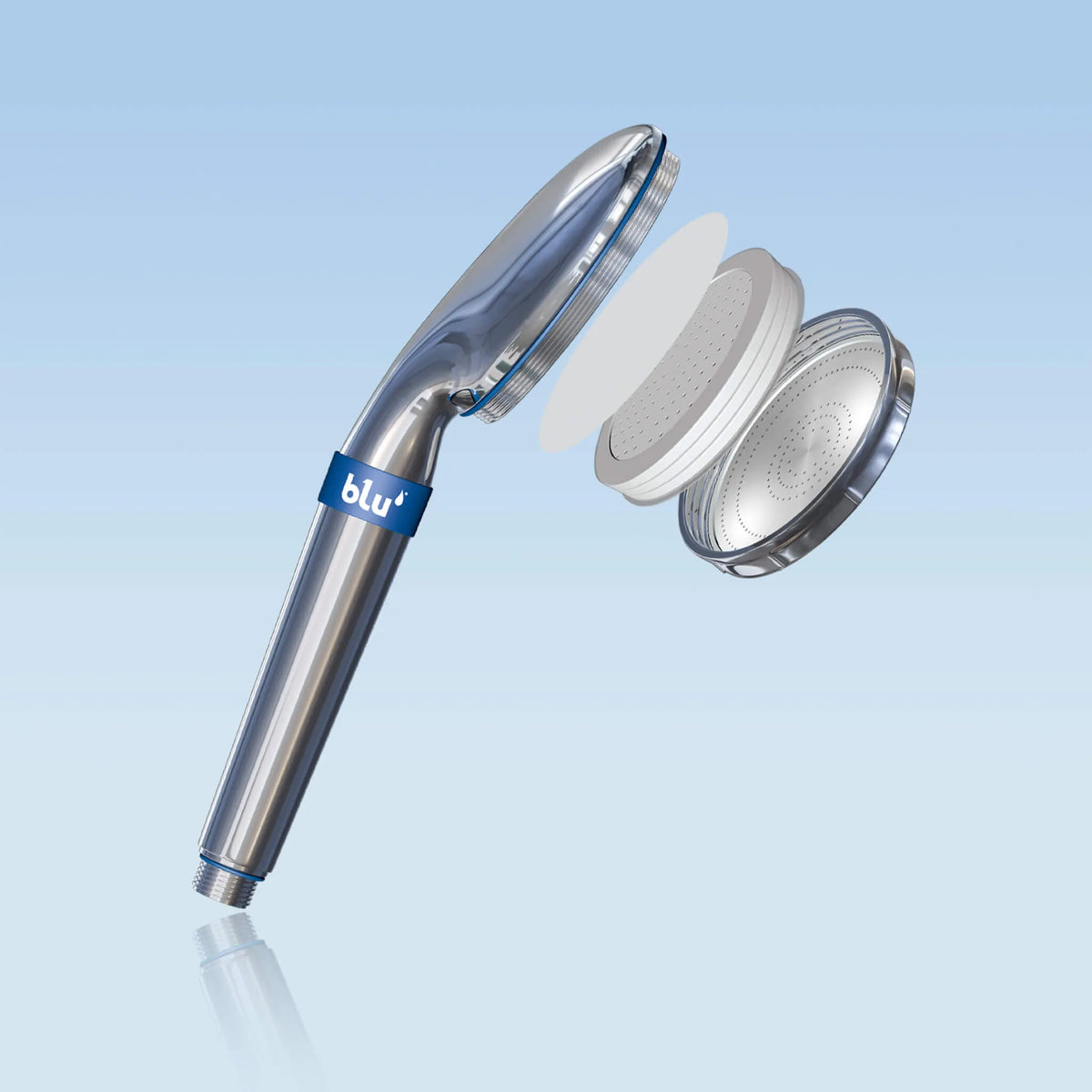
Before you spend anything: no shower filter softens water. Carbon and NMC media do not reduce calcium or magnesium, so any shower filter marketed as "softening" is describing something it does not do. That job needs ion exchange, where resin beads swap the hardness minerals out — a whole-house softener, or blu's separate NXT LVL Shower Softener & Filter, which threads on ahead of the filter and uses Seplite ion-exchange resin.
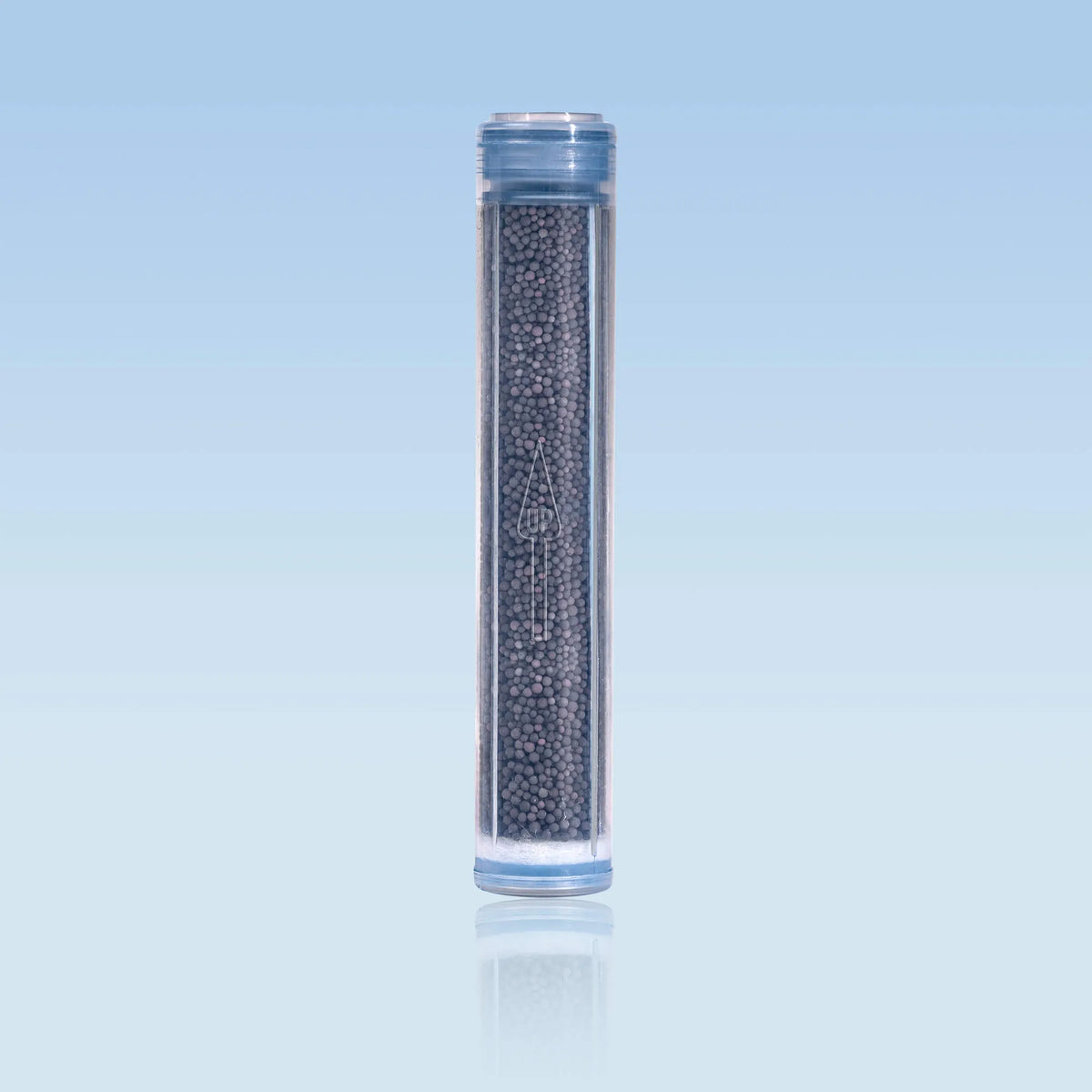
What a certified filter does is address the other half. blu's Ionic Shower Head & Filter is built on an NSF/ANSI 42 certified filtration medium — the standard covering chlorine, taste and odour — and reduces chlorine, heavy metal ions, dirt and odours in the water passing through it. That takes the oxidising half out of your daily wash and leaves the mineral half to the routine below. How it works is on The Science.
| The problem | What it does to curls | What actually addresses it |
|---|---|---|
| Calcium and magnesium (hardness) | Mineral film, dullness, lost clumping, poor lather | Chelating shampoo; ion exchange. Not a filter. |
| Chlorine and heavy metal ions | Oxidises and roughens the cuticle, strips sebum | A certified filter at the shower head |
| Mechanical stress | Cracks at twist points, mid-strand snapping | Detangle wet with slip; wide-tooth comb; microfibre |
| Build-up already on the fibre | Weighs strands down, blocks conditioner | Clarify it out; no filter undoes it retrospectively |
Which model suits your texture: our guide to choosing a shower filter for your hair type.
A curl routine built for UAE water
- Clarify on a schedule, not a whim. A chelating shampoo — formulated with ingredients that bind metal ions — is the single most useful change most curly-haired people make in a hard-water city.
- Filter the chlorine out of every wash. The daily-exposure half, and the half you can fix at the shower head.
- Go gentle on surfactants in between. Sulfate-free cleansers are less affected by the lather-killing effect and less stripping on a dry fibre.
- Detangle soaking wet, with conditioner in. Given where curly fibres crack, fingers or a wide-tooth comb under slip — never a brush on dry hair — is structural, not a preference.
- Finish cooler. A cooler final rinse helps the cuticle lie flatter.
- Stop using a terry towel. Microfibre or a cotton t-shirt; terry loops catch on lifted cuticle.
- Protect it overnight. A satin pillowcase or a loose protective style spares hours of friction a night.
Frequently asked questions
Does hard water ruin curly hair?
"Ruin" is too strong. What is documented is that hair washed in hard water carries three to four times more calcium and magnesium, and that film dulls hair, blocks clumping and makes shampoo lather poorly. Whether it weakens the fibre is contested: one study found no effect on tensile strength, a later one using harder water found a significant loss.
Will a shower filter soften hard water for my curls?
No, and be sceptical of any that claims to. No shower filter reduces calcium and magnesium; that needs ion exchange — a plumbed-in softener, or blu's separate NXT LVL Shower Softener & Filter. A certified filter reduces chlorine and heavy metal ions, the other half of the damage.
Why do my curls lose definition in Dubai specifically?
Definition depends on clean strands grouping together. Mineral film coats and weighs down individual strands so they stop clumping, and an oxidised, roughened cuticle adds friction and frizz. The two effects stack, and textured hair shows them first because it is drier and more fragile to begin with.
How often should I clarify curly hair in a hard-water area?
Often enough that film never builds to the point where products stop working — for most people in the UAE, a chelating wash every few weeks rather than twice a year. Fine or low-porosity curls need it sooner.
Will filtering the water fix build-up I already have?
No. A filter changes the water arriving from today onward; minerals already on the fibre have to be clarified out. Pair the two rather than expecting one to do the other's job.
How long before my curls look different?
The water feels different from the first shower. Beyond that, judge over weeks rather than days — the curl you can see is largely new growth plus whatever breakage you prevented. Results vary.
Sources
- Srinivasan & Rangachari, Scanning electron microscopy of hair treated in hard water, Int J Dermatol, 2016;55(6):e344–6.
- Srinivasan et al., Effects of hard water on hair, Int J Trichology, 2013;5(3):137–9 — the null result.
- Luqman et al., Changes in baseline strength of hairs treated with deionized and hard water, Int J Trichology, 2018;10(3):113–7.
- Camacho-Bragado et al., Understanding breakage in curly hair, Br J Dermatol, 2015;173(Suppl 2):10–16.
- Van den Berg et al., Quantifying whole human scalp hair fibres of varying curl, J Microsc, 2025.
- Evans, Marsh & Wickett, The structural implications of water hardness metal uptake by human hair, Int J Cosmet Sci, 2011;33(5):477–82.
- Danby et al., The Effect of Water Hardness on Surfactant Deposition after Washing, J Invest Dermatol, 2018;138(1):68–77.
- blu, The Science — the NSF/ANSI 42 certified filtration medium and blu's laboratory measurements.
General information about water quality and hair care, not medical advice. If you have significant hair loss or a persistent scalp condition, please see a doctor.




Leave a comment