


Itchy Skin After Showering in Dubai: Is Your Water the Cause?
Itchy skin after every shower in Dubai? What the research really shows about hard and chlorinated water, why a filter and a softener are not interchangeable, and when to see a doctor instead.

Woman scratching irritated skin, blu Ionic Shower Filter handheld alongside
Your skin starts prickling within minutes of towelling off, and it only started after you moved to the UAE. Your shower water is a reasonable suspect — but not the only one, and some causes of itching need a doctor rather than a new shower head.
Here is how to tell water-driven itching from everything else, what the research actually shows about hard and chlorinated water, and which fix addresses which problem.
- Hard water leaves body wash behind. A 2018 Journal of Investigative Dermatology study found skin washed in hard water carried significantly more surfactant deposit, which increased water loss through the skin and caused irritation.
- Chlorine is a smaller, separate effect. Residual chlorine measurably reduced the barrier's water-holding capacity in a 2003 study — but the 2018 study found no clear chlorine effect of its own.
- Filters and softeners solve different problems. A shower filter reduces chlorine and heavy metal ions; it does not soften water. Only ion-exchange resin removes calcium and magnesium.
- The free changes matter most. Shorter, cooler showers, less soap, moisturiser within three minutes.
- Itching all over with no rash needs a GP, not a shopping decision — the NHS lists thyroid, liver and kidney problems among the less common causes.
What water-driven itching looks like
No test proves your water is the culprit, but the pattern is fairly distinctive. Itching linked to shower water usually:
- starts within minutes of getting out, not hours later
- comes with a tight, over-cleaned feeling rather than a rash
- is worst on arms, legs and back — where you soap and rinse most
- is worse after long, hot showers and better after short, lukewarm ones
- started or worsened after you moved here, or changed buildings
- affects more than one person in the household
If your itching is constant regardless of showering, or comes with symptoms elsewhere, skip to when itching means seeing a doctor — that pattern points somewhere else.
Why UAE shower water irritates skin
UAE tap water starts as seawater, is desalinated, treated and chlorinated, then travels through long, hot pipes and often a rooftop tank before it reaches you. It is safe — that is what the treatment is for. It is just hard on skin, for three reasons that stack.
1. Hard water leaves your body wash behind
This is the best-evidenced mechanism, and it is less about the water than what it does to your soap. Hard water carries dissolved calcium and magnesium — the minerals that scale your shower glass — and those react with the surfactants in body wash so the residue does not fully rinse away.
Researchers at the University of Sheffield and King's College London showed this directly. In a 2018 Journal of Investigative Dermatology study, 80 participants had skin washed with sodium lauryl sulfate in water of varying hardness. Sites washed with hard water carried significantly more surfactant deposit; those deposits increased transepidermal water loss — how fast skin leaks moisture — and caused irritation, particularly in eczema patients carrying filaggrin gene mutations. Ion-exchange softening mitigated the effect.
In short: in hard water, your body wash does not fully leave when you rinse.
2. Chlorine reduces how much water your skin can hold
A chlorine residual is deliberately maintained in the supply so water stays microbiologically safe across the whole network — standard World Health Organization practice, with a measurable cost to the skin barrier.
In 2003, researchers in the Journal of Dermatology immersed forearms for ten minutes in warm water at controlled residual-chlorine levels. In people with atopic dermatitis, the water-holding capacity of the stratum corneum — the skin's outermost barrier layer — dropped significantly at 0.5 mg/L and above. In healthy controls, only at 2.0 mg/L.
Two honest caveats. A ten-minute arm soak is not a shower. And the 2018 hard-water study tested chlorine alongside hardness and reported that a clear effect of chlorine was not observed — so chlorine's contribution to washing-related irritation is less settled than the hardness one.
3. Heat and air conditioning finish the job
Hot water lifts the lipids holding your barrier together far more effectively than warm water. Then you step into air conditioning, which strips moisture from the air as it cools — and most of us spend nearly the whole day in it. None of these is dramatic alone; stacked daily, they are why a routine that worked elsewhere stops working here.
A relief routine you can start tonight
These cost nothing and address the biggest variables first, following standard dermatology guidance rather than anything proprietary.
- Turn the temperature down and the clock forward. The American Academy of Dermatology advises limiting baths and showers to five to ten minutes in warm — not hot — water. The single highest-value change here.
- Switch to a mild, fragrance-free wash and use less of it. Heavily foaming cleansers strip more and, in hard water, leave more residue behind.
- Don't soap everywhere, every day. Arms, legs and back rarely need a full lather daily.
- Pat dry, don't rub, and leave skin slightly damp — rubbing irritates dry skin further.
- Moisturise within about three minutes of getting out, while skin still holds water. Applied to bone-dry skin, a moisturiser has far less to seal in.
- Cool the itch rather than scratching it. A damp, cool cloth is the NHS's advice; constant scratching breaks the barrier and prolongs the cycle. Keep nails short.
- Wear loose cotton rather than wool or synthetics, which the NHS lists among things to avoid.
Filter, softener, or neither
If you have done all of the above for a few weeks and your skin still tightens after every shower, the remaining variable is the water — at which point it matters enormously which device you buy, because they do different jobs and the marketing blurs them.
| What you want changed | Shower filter | Whole-house ion-exchange softener |
|---|---|---|
| Chlorine and chloramine | Reduced | No |
| Heavy metal ions (lead, cadmium) | Reduced | No |
| Calcium & magnesium (hardness) | No change | Removed |
| Surfactant residue left by hard water | Unchanged | Reduced |
| Limescale on glass and fittings | No | Yes |
| Treats eczema or dermatitis | No | No |
| Fitting | Screws on, no plumber | Plumbed in, thousands of dirhams |
So if the mechanism bothering you is the surfactant-residue one, a filter is the wrong tool and this article will not pretend otherwise. A plumbed-in softener is the tool — and for most UAE renters, not an option. If it's the hardness minerals themselves you want reduced, that's what blu's NXT LVL Shower Softener & Filter is for: it threads on ahead of your filter and runs the water through Seplite® ion-exchange resin. We compare the two in shower filters vs. water softeners.
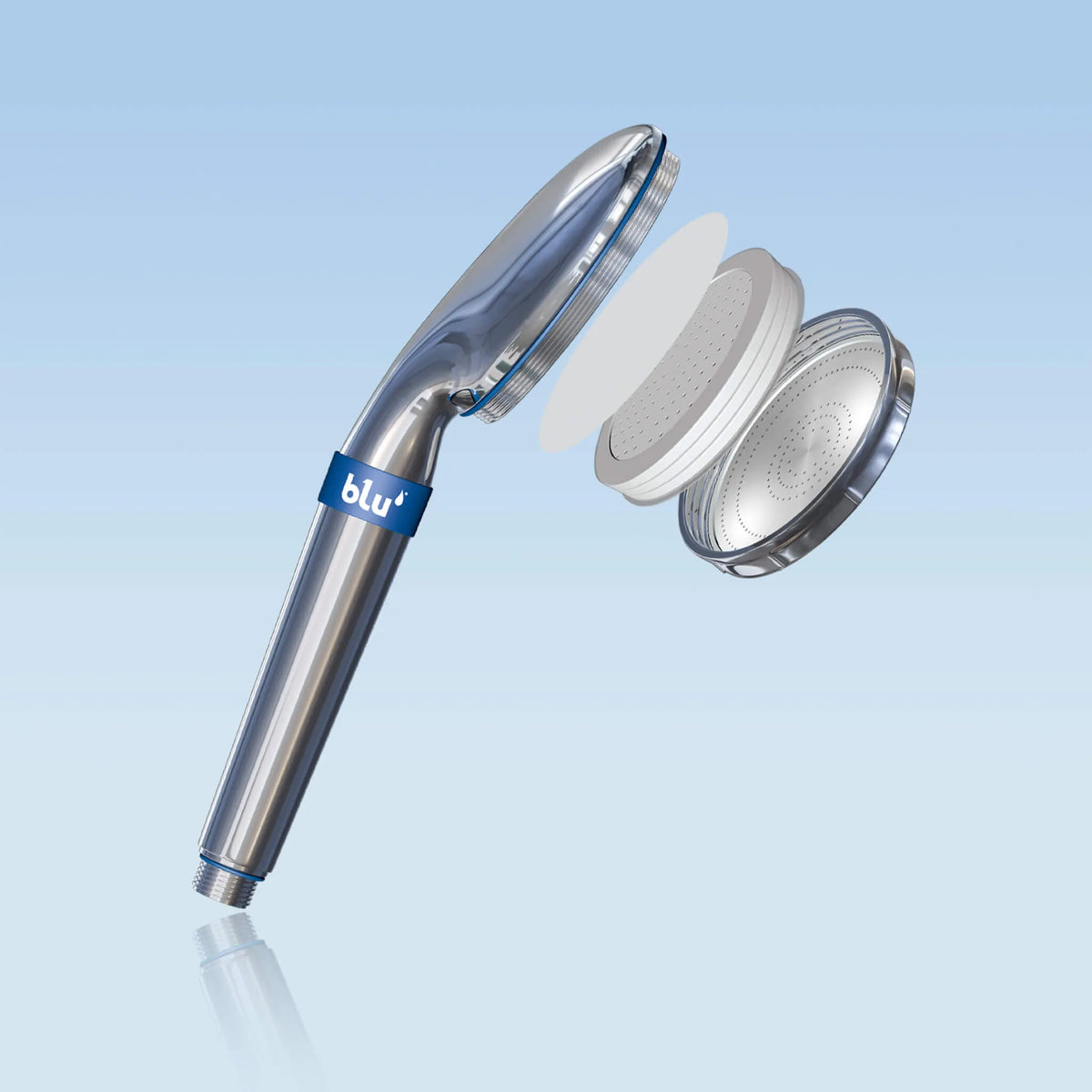
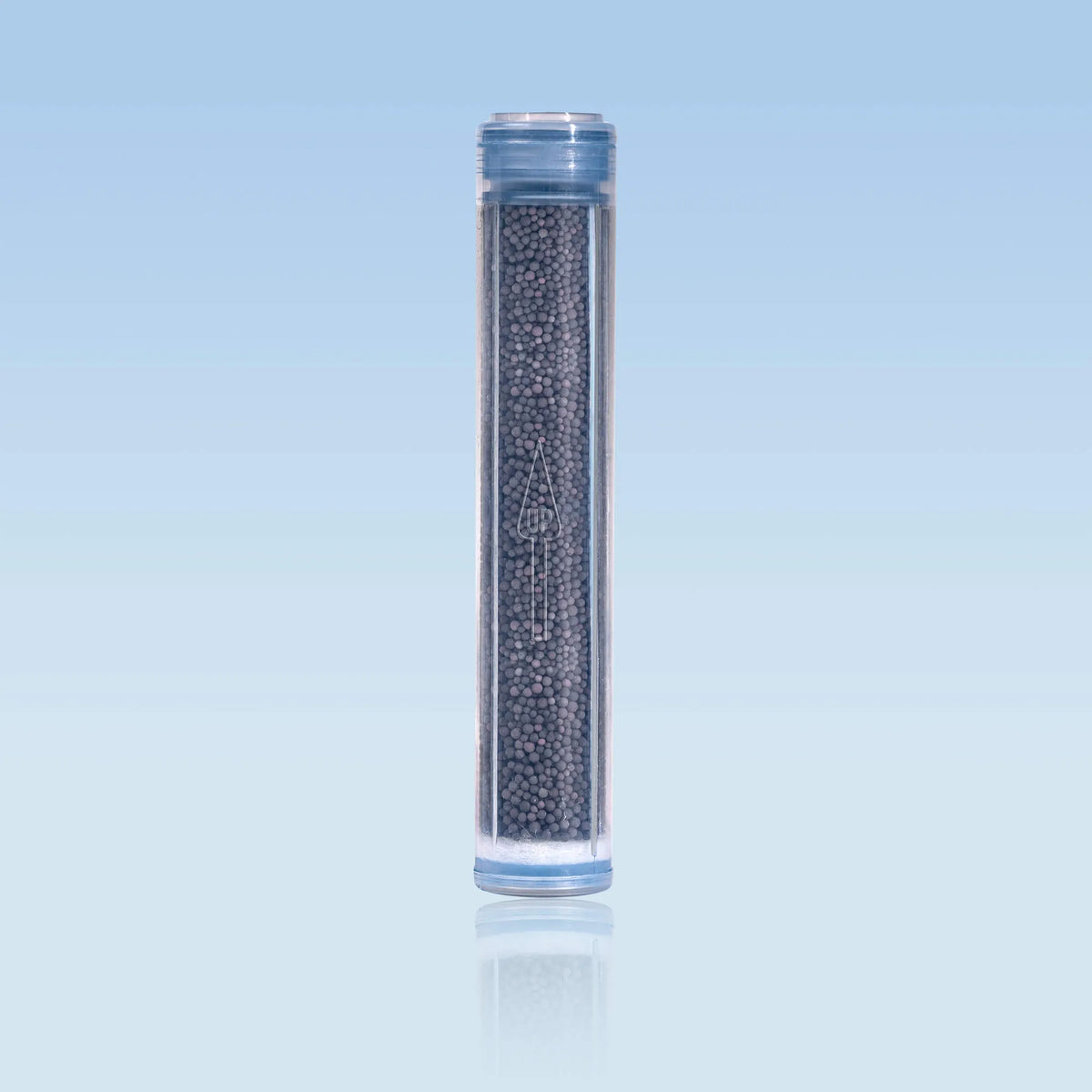
What a filter does address is the chlorine and metals arriving at your skin every morning. blu's Ionic Shower Head & Filter is built on an NSF/ANSI 42 certified filtration medium — NSF's public listings show the NMC media certified as components under that standard, covering chlorine, taste, odour and particulate. It reduces chlorine, dirt and odours; in independent Eurofins testing (report EFSN24031276, 2024), free residual chlorine fell from 17.09 mg/L to 0.09 mg/L, a 99.5% reduction. The media is also designed to reduce heavy metal ions such as lead, though blu's heavy-metals test for the Ionic filter is not yet complete. Detail on The Science page.
The limits, plainly. It is not a water softener, so hardness is unchanged, and it is not a medical device or a treatment for any skin condition. In blu's voluntary, incentivized in-house survey of 2,380 verified customers in May and July 2026, 89% self-reported at least one positive change and 77% a better shower experience or improved water feel — perception, not measurement, with the method on Results. The 30-day money-back guarantee is the honest way to test a claim like this.
When itching means seeing a doctor
Itching is a symptom, not a diagnosis, and plenty of causes have nothing to do with your shower. This is where an honest article stops selling.
The NHS advises seeing a GP if itching affects your daily life, does not improve with self-care or keeps coming back, comes with a new rash, lump or swelling, is all over your body, is severe, or happens during pregnancy. Less commonly, it notes, itchy skin can signal thyroid, liver or kidney problems.
Get urgent help if itching arrives with swelling of the lips, tongue, throat or face, difficulty breathing, a rash that does not fade when pressed, fever with feeling very unwell, or yellowing of the skin or eyes.
None of that is replaced by filtering your water, and a device claiming to treat it is one to walk away from.
Frequently asked questions
Can shower water really make you itch?
It can contribute. The strongest evidence is for hard water leaving surfactant residue on skin after rinsing, which increases water loss through the barrier and causes irritation. Chlorine has a separate, less settled effect. Whether water is the main driver for you depends on your skin and the rest of your routine.
Will a shower filter stop my itching?
Possibly not, and it is worth being clear why. A filter reduces chlorine and heavy metal ions. It does nothing about hardness, the mechanism with the best evidence behind it. It takes one input out of the stack; it is not a treatment and cannot address causes that are not water-related.
Is it the hardness or the chlorine irritating my skin?
The published evidence is stronger for hardness, via the residue it leaves from your body wash. Chlorine has been shown to reduce the barrier's water-holding capacity in immersion studies, but the 2018 washing study found no clear chlorine effect. They arrive together from the same shower head, which is why it is hard to out-moisturise.
I have eczema — is a shower filter safe to use?
It is a low-risk addition, and the research suggests compromised skin reacts at lower chlorine concentrations than healthy skin. But it is not a substitute for treatment: use it alongside whatever your dermatologist has prescribed, and raise any new product with them first.
Would a water softener be better for my skin?
For the hardness mechanism specifically, the evidence points that way — ion-exchange softening mitigated the effect in the 2018 study. The catch with a whole-house softener is cost and plumbing, which rules it out for most renters. The two devices are not interchangeable.
How long before I notice a difference?
The water feels different from the first filtered shower, but that is a sensation. Any change in skin builds over weeks, varies by person, and is not guaranteed. If nothing has changed after a few weeks of the routine above, see a doctor rather than buy another product.
Sources
- Hard water, surfactant deposition, water loss and irritation — Danby SG et al., J Invest Dermatol, 2018
- Residual chlorine and the stratum corneum — Seki T et al., J Dermatol, 2003
- Causes, self-care and when to see a GP — NHS, Itchy skin
- Shower length, temperature, moisturiser timing — AAD, tips for relieving dry skin and AAD, home remedies for itch relief
- Chlorine residual through distribution — WHO chlorine fact sheet
- NSF/ANSI 42 component certification of the NMC filter media — NSF Official Listings; survey figures — bludubai.com/pages/results, retrieved September 2026.
- Eurofins chlorine-reduction test report — Eurofins report EFSN24031276, 2024




Leave a comment