


The Best Shower Filter for Your Hair Type in the UAE
Fine, curly, colour-treated, covered or sensitive: what UAE water does to each hair type, which problems a shower filter is actually relevant to, and what it cannot fix.

Woman showering with the blu Ionic Shower Head with Built-in Shower Filter handheld against a blue background
There is no shower filter designed for curly hair, and none designed for fine hair either. The water arriving at your shower is identical whatever is on your head; the cartridge cannot tell the difference and does not need to.
What genuinely differs is what each hair type notices first, which problems filtration is relevant to, and what you should pair it with. That is what this guide covers — plus the things sold as hair-type solutions that are not solutions at all.
- Buy on certification and cartridge economics, not on hair type. The filter is the same; the pairing is what changes.
- Fine hair notices product build-up first, curls notice lost definition, blondes notice colour shifts, covered hair notices the scalp.
- Green tints in blonde hair come from copper, not chlorine. Chlorine's role is to damage the cuticle so copper can bind.
- No shower filter softens water, so nothing here fixes mineral deposit on the strand. That is a job for an occasional chelating shampoo.
- A flaking, painful or spreading scalp is a medical problem. See a dermatologist before you buy anything.
The short answer
The best shower filter for your hair type is simply the best shower filter: one with a certification you can verify, a medium that holds up in hot fast-flowing water, and cartridges you can afford to replace on schedule. Hair type does not change the specification.
What it changes is your expectations. Filtration acts on chlorine and other water pollutants. If your problem is chlorine-related roughness, that is the right lever. If it is humidity, heat damage, bleach, tight styling or a scalp condition, the water was never the variable and a filter will disappoint you.
What UAE water does to all hair
Two mechanisms, and the evidence is genuinely uneven.
Chlorine oxidises the hair fibre. The clearest evidence comes from swimmers. Nanko and colleagues compared 67 elite Japanese swimmers with 54 controls: 61% of the swimmers had visible hair discolouration against none of the controls, and electron microscopy showed the cuticle had gone entirely in discoloured hair, with chlorine detectable in the cortex. The authors attributed the cuticle loss mainly to friction with water, with hypochlorous acid then able to penetrate and oxidise the pigment. Keep the scale in mind: that is hours a day in a pool, not ten minutes in a shower.
Hardness is contested. Srinivasan and colleagues soaked hair in hard and distilled water for 30 days and concluded hardness does not affect tensile strength or elasticity. Luqman and colleagues, running a similar design twice with larger samples, found hard water significantly weakened hair. Three small ex-vivo studies, two results. Anyone quoting one as settled is quoting selectively.
What is not contested: a chlorine residual is deliberately maintained in distribution water, and that water picks up sediment and metal traces from pipework and rooftop tanks on the way to your building. Reducing what is in the water is the part a filter can do.
By hair type
Fine or thin hair
You notice weight before damage: hair goes flat, dull and needs washing sooner. Fine strands have less mass, so the same deposit shows up more. Filtration is relevant to the chlorine part; the deposit is mineral, and no filter addresses that. Pair a filter with a lightweight conditioner and an occasional chelating wash, and resist washing more often, which usually makes the cycle worse.
Curly and coily hair
Curls show damage as lost definition and frizz rather than breakage, because a lifted cuticle is more visible on a curved strand and reflects light badly. Curly hair is also drier by structure — sebum travels down a coil poorly — so it starts with less protection against anything oxidative. If your curl pattern has gone limp since moving to the UAE, the water is a reasonable suspect. So is the humidity.
Colour-treated and bleached hair
This is where the category's most common claim is backwards. Green tints in blonde hair come from copper, not chlorine. As chemist Magdalena Wajrak explains, copper ions bind to keratin to form a copper-keratin complex, and hair exposed to chlorine alone did not turn green; chlorine's role is damaging the hair so that broken disulfide groups give copper somewhere to bind. Bleached and processed hair has the most broken bonds, which is why it discolours most.
The consequence: for colour-treated hair, a filter designed to reduce dissolved metal ions does more relevant work than one handling only chlorine. Pool copper concentrations are far higher than anything in a domestic tap, so keep the expectation proportionate — and if you swim, rinse before and after.
Hair you keep covered
Under a hijab, cap or helmet the issue is usually the scalp rather than the strand: warmth, moisture and friction with no chance to dry. Chlorine-related dryness compounds it. The highest-value change here is not the filter — it is drying your hair fully before covering it, every time. A filter is a reasonable addition; drying is the intervention.
Sensitive or flaky scalp
Tightness and itch immediately after showering point at the water; flaking, redness and anything spreading point at a condition needing diagnosis. A filter may help the first and does nothing for the second. Shower filters do not treat, cure or prevent seborrhoeic dermatitis, psoriasis or scalp infection. If it is sore, spreading or not settling, see a dermatologist first and change your water second.
Quick reference
| Hair type | What you notice first | Is filtration the right lever? | Pair it with |
|---|---|---|---|
| Fine / thin | Flat, dull, washing more often | Partly — chlorine yes, deposit no | Lightweight conditioner, occasional chelating wash |
| Curly / coily | Lost definition, frizz | Yes, for the oxidative part | Leave-in moisture, gentler detangling |
| Colour-treated | Fast fade, brassiness, green cast | Yes, with a medium designed to reduce metal ions | Rinsing before and after swimming |
| Covered | Itchy scalp, hairline breakage | Secondary | Drying fully before covering — the main fix |
| Sensitive scalp | Tightness right after showering | Possibly, for tightness only | A dermatologist, if there is flaking or soreness |
How to judge a filter, whatever your hair
Almost every filter on the shelf claims to take out chlorine. The useful question is whether anyone independent has checked, and against what.
NSF/ANSI 177 is the shower-specific standard: material safety, structural integrity, and at least a 50% reduction of free available chlorine from a 2.0 mg/L challenge across the rated service life, tested under simulated shower conditions. A real bar, and a narrow one — it says nothing about metals.
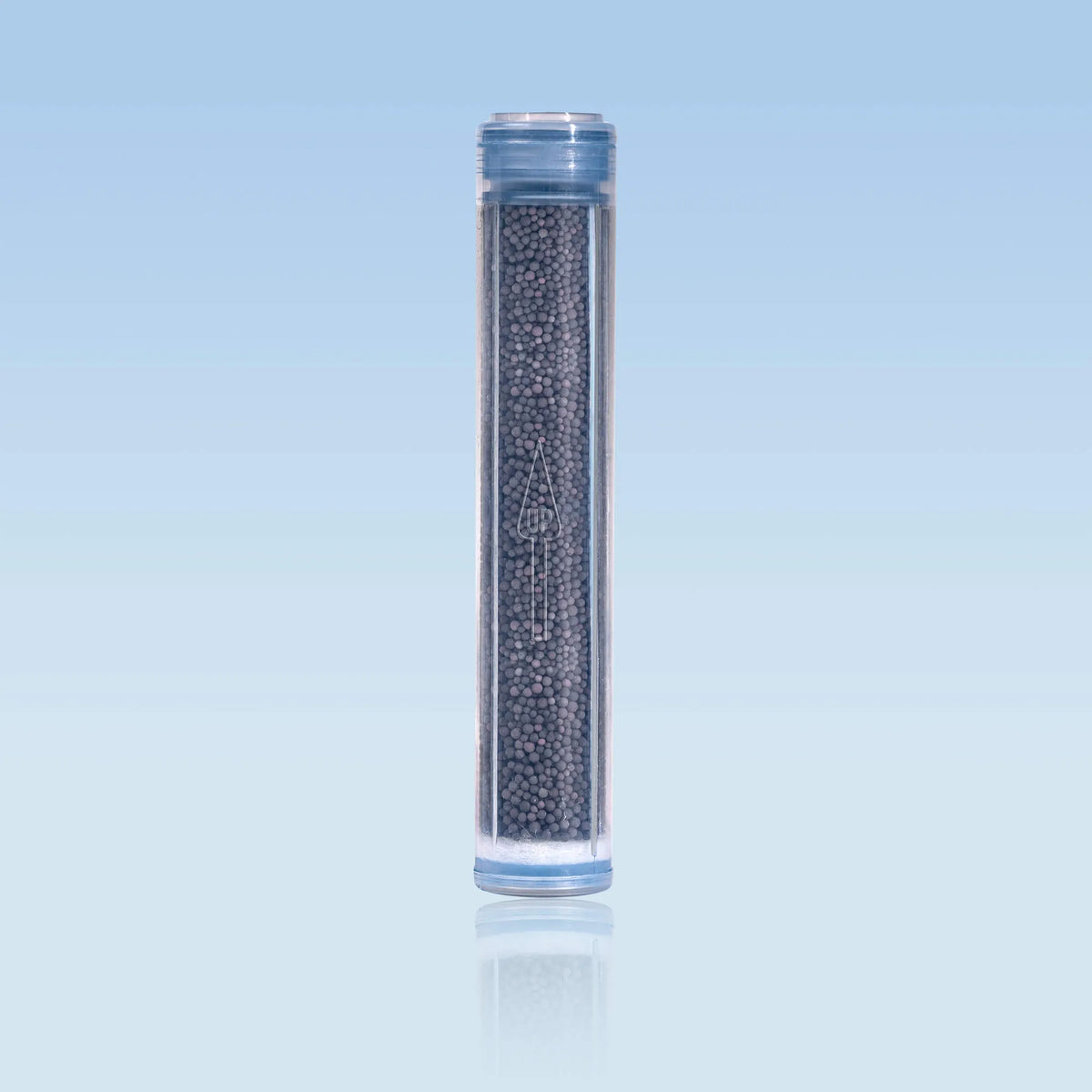
NSF/ANSI 42 is the broader drinking-water standard for aesthetic effects. blu's cartridge is built on an NSF/ANSI 42 certified filtration medium, which certifies the medium rather than the finished shower head or the company — a distinction this category blurs, and one we have not always stated as carefully as we should have.
Then check the economics. Ask for rated life in litres rather than months, divide the refill price by it, and multiply by what your household uses. blu publishes AED 199 for a six-pack of NMC refills — the same price whichever model you have — rated at roughly 4,000 litres each, and puts typical household use at three to six cartridges a year, so AED 100 to AED 199 a year. Prices retrieved 15 September 2026; check the product pages, because they move. Run the same sum on anything you compare.
Be sceptical of any filter promising to cure hair loss, boost immunity or soften your water. All three are common here, and all three are wrong.
What it will not do
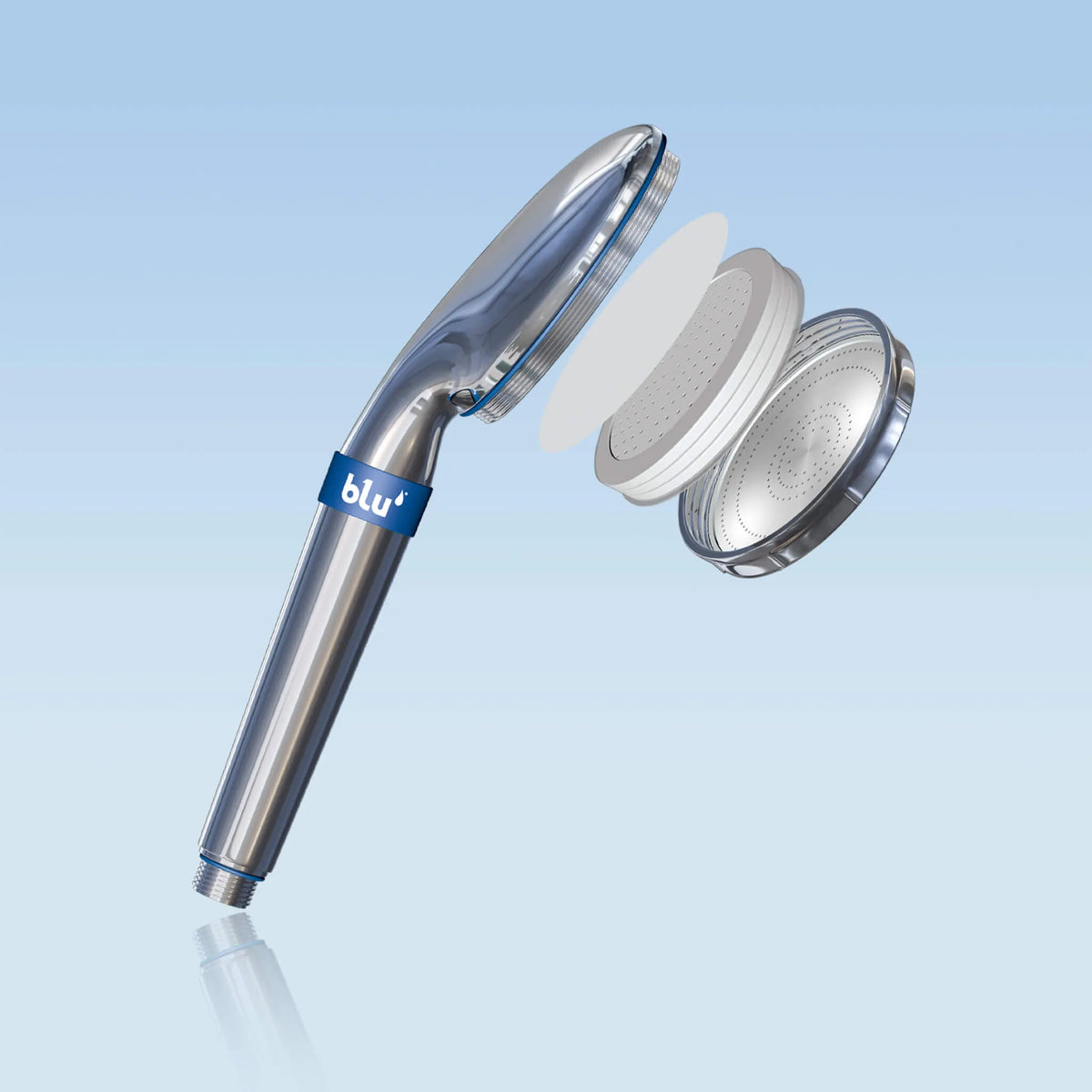
It will not soften your water. No shower filter reduces calcium and magnesium — the blu Ionic is carbon and NMC filtration, and media of that type don't reduce hardness — so mineral deposit on the strand is untouched. That matters more for hair than people expect, because deposit is what makes fine hair go flat and curls go dull. It is a chelating shampoo's job, not a filter's. If it's the hardness minerals themselves you want reduced, that's what blu's NXT LVL Shower Softener & Filter is for: it threads on ahead of your filter and runs the water through Seplite® ion-exchange resin.
It will not repair damage already done. Hair is dead tissue; a lifted cuticle does not re-seal. What changes is the condition of new growth and the rate at which existing length degrades, which is why four to eight weeks is the honest window for judging anything.
And it will not replace a diagnosis. In blu's voluntary, incentivized, self-reported survey of 2,380 verified customers across May and July 2026, 43.4% reported healthier, softer hair — a perception survey run in-house with a completion voucher, not a clinical measurement. Individual results may vary. Useful signal, not evidence about hair fibres, and no substitute for seeing someone if your scalp is genuinely unwell.
Frequently asked questions
Is there a shower filter made for curly hair?
No, and be wary of anything marketed that way. The water is the same for every hair type and the cartridge chemistry does not vary. What varies is what you notice and what you pair the filter with.
Will a filter stop my colour fading?
It will not stop it. Colour fades from washing, heat, UV and oxidation regardless of your water. Reducing chlorine, with a medium designed to reduce the metals that bind to bleached hair, takes away one contributor, and that is the honest size of the claim.
Does a shower filter soften water for hair?
No. No shower filter softens water. If squeaky, dull, mineral-coated hair is your specific complaint, a filter is not the answer — an occasional chelating shampoo is closer to it, or a plumbed-in softener if you own your home.
My hair got worse after moving to the UAE. Is it the water?
Possibly, but check the other variables first: a new climate, air conditioning, more sun, a different water temperature, and often a period of real stress. Diffuse shedding after a big life change usually shows up about three months later, and that timing catches a lot of people out.
How long should I trial a filter before deciding?
Eight weeks, changing nothing else. Photograph your hair in the same light on day one, keep your products and heat tools identical, and compare the photographs rather than your memory. Feel changes within a few washes; condition takes longer.
Sources
- Nanko H et al., Hair-discoloration of Japanese elite swimmers, Journal of Dermatology, 2000.
- Wajrak M, Why does my hair turn green from the swimming pool?, The Conversation — copper, not chlorine, causes the green.
- Srinivasan G et al., Effects of hard water on hair, International Journal of Trichology, 2013 — found no effect on tensile strength.
- Luqman MW et al., Changes in baseline strength of hairs after treating them with deionized water and hard water, International Journal of Trichology, 2018 — found hard water reduced strength.
- American Academy of Dermatology, Hair loss: 18 causes.
- NSF, NSF/ANSI 177 shower filter certification.
- World Health Organization, Chlorine in drinking-water fact sheet.
- blu, Results and Ionic Shower Head with Built-in Shower Filter — survey method, cartridge ratings and prices quoted above.
Related: hard water and curly hair, and why Dubai's water is so hard on hair and skin.


Leave a comment