


Does Dandruff Cause Hair Loss? What the Evidence Actually Says
Dandruff does not cause hair loss directly — scratching and scalp irritation do, and that shedding is not permanent. The evidence, how to tell it apart from pattern loss, and where UAE water fits.

Woman scratching the back of her head, three blu Ionic Shower Filter handhelds alongside
Flakes on your shoulders, hair in the shower drain — the two feel obviously connected. The evidence says they mostly are not, at least not in the way people assume.
Here is what dandruff can and cannot do to your hair, how to tell dandruff-related shedding from the two kinds of hair loss it gets confused with, and where UAE shower water fits in.
- No, dandruff does not cause hair loss directly. It does not kill follicles and it does not cause pattern baldness.
- It can cost you hair indirectly. Cleveland Clinic lists "hair shedding from scratching in affected areas" as a symptom of seborrheic dermatitis — and is explicit that this is not permanent hair loss.
- Dandruff is common. PLOS ONE research notes over half the world's population will experience it at some point.
- Treat the itch, not the flake. Scratching is the mechanism that actually costs hair, so breaking that cycle is the highest-value change.
- Shower water does not cause dandruff — yeast, sebum and your own biology do. Chlorinated water can dry the scalp: a contributing factor, not a cause.
Does dandruff cause hair loss?
No — not directly. Dandruff does not destroy hair follicles, and it plays no part in the patterned thinning most people mean when they say "hair loss".
What it can do is make you scratch. Cleveland Clinic lists hair shedding from scratching affected areas among the symptoms of seborrheic dermatitis, with the qualifier in the same line: but not permanent hair loss. That tells you what to fix — calm the scalp, stop the scratching, and the shedding typically settles.
It also tells you what a calmer scalp will not fix. If your hairline is receding or your crown is thinning, that is a different mechanism, and no shampoo or shower head changes it.
What dandruff actually is
Dandruff is the mild, scalp-only end of seborrheic dermatitis — the same condition, turned down. The signs are familiar: white or yellowish flakes, patches of greasy scale, and an itch that is hard to leave alone.
Three things are consistently involved, according to Cleveland Clinic: an overgrowth of Malassezia, a yeast that lives on nearly everyone's skin; oily skin for it to feed on; and individual susceptibility. Genetics, some neurological conditions and certain medications raise the risk, and flares track with stress, cold dry weather and harsh products.
It is also extremely common: a 2019 PLOS ONE study of healthy and dandruff-affected scalps notes over half the world's population will experience dandruff in their lifetime, and found it associated with greater frequencies of M. restricta and Staphylococcus. Note what is not on that list: shampoo frequency, hair type and water quality are not causes.
How dandruff can lead to shedding
The route from dandruff to hair in the drain runs through your fingernails, not your follicles.
Scratching breaks hair
Persistent scratching and rubbing put mechanical stress on hair; repeated friction on an irritated scalp snaps strands and pulls loose hairs that were on their way out anyway. The hair in your brush is largely hair that broke — not follicles that died.
An inflamed scalp is a harder place to grow hair
This is where honest writing has to slow down. Dermatology sources treat the inflammation, not the flakes, as the thing worth addressing. But seborrheic dermatitis is not among the established triggers of telogen effluvium — the diffuse shedding people usually have in mind. StatPearls names febrile illness, major surgery, postpartum hormonal change, thyroid problems, crash dieting and iron deficiency, typically about three months before shedding starts. Scalp inflammation is not on that list.
So the defensible statement is narrower than the internet's version: scratching an itchy scalp costs you hair through breakage, and that recovers. Claims that dandruff itself sheds a specific percentage of your hair are not supported by the sources making them.
Telling the three apart
Most confusion here comes from two or three things happening at once, with different causes, patterns and fixes.
| Dandruff-related shedding | Telogen effluvium | Androgenetic alopecia | |
|---|---|---|---|
| What drives it | Scratching and scalp irritation | A systemic trigger — illness, surgery, childbirth, iron deficiency — about 3 months earlier | Genetics plus follicle sensitivity to DHT |
| What it looks like | Breakage alongside flaking and itch | Sudden, diffuse shedding across the scalp | Receding hairline or crown thinning, slowly |
| Does it reverse? | Yes — explicitly not permanent | Usually, once the trigger has passed | No. Progressive; affects roughly half of men and women |
| What helps | Medicated shampoo; stop scratching | Treating the cause, then time | A dermatologist and prescription treatment |
If you have dandruff and a receding hairline, clearing the dandruff helps the itch, flakes and breakage — but not the pattern loss. That is a conversation for a doctor, not a shopping decision.
What UAE water has to do with it
Your shower water does not cause dandruff. Malassezia, sebum and your own biology do, and no amount of filtration changes any of the three. What water can do is leave the scalp drier and more reactive — which feeds the itch, which feeds the scratching.
UAE tap water is desalinated and deliberately chlorinated so it stays safe across a long, hot distribution network. Good public health engineering — simply not designed around your scalp.
The measurement most often cited is a 2003 study in the Journal of Dermatology. Researchers immersed forearms in warm water at controlled residual-chlorine levels and measured the water-holding capacity of the stratum corneum, the skin's outermost barrier layer. In atopic dermatitis it dropped significantly at 0.5 mg/L and above; in healthy controls, only at 2.0 mg/L. Two caveats: ten minutes of arm immersion is not a shower, and skin is not scalp.
Hardness is a separate question with genuinely mixed evidence. A 2018 International Journal of Trichology study found hard water reduced hair's tensile strength and concluded it increases breakage; a 2013 study in the same journal found no significant effect. Worth knowing before anyone sells you a solution to it — fuller picture in why Dubai's water is hard on your hair and skin.
A scalp routine that holds up here
1. Use a medicated shampoo properly
This is the treatment; everything else is support. The American Academy of Dermatology points to antifungal shampoos — ketoconazole can diminish the rash, itch and scale, and prescription ciclopirox works on rash, scale and itch. Massage it into the scalp, not the hair, and leave it on for the time the label or your dermatologist specifies. Most people cut the contact time short, then conclude the shampoo does not work. Frequency depends on hair type: AAD guidance is two to three times weekly for straight or wavy hair, about weekly for curly or tightly coiled hair.
2. Break the scratch cycle
Since scratching is what actually costs you hair, this is the highest-value habit change here. Keep nails short, treat the itch rather than picking at the flake, and keep showers brief — AAD advises five to ten minutes in warm, not hot, water.
3. Take one daily irritant out of the water
If chlorinated water is drying your scalp every morning, that is a daily input you can change.
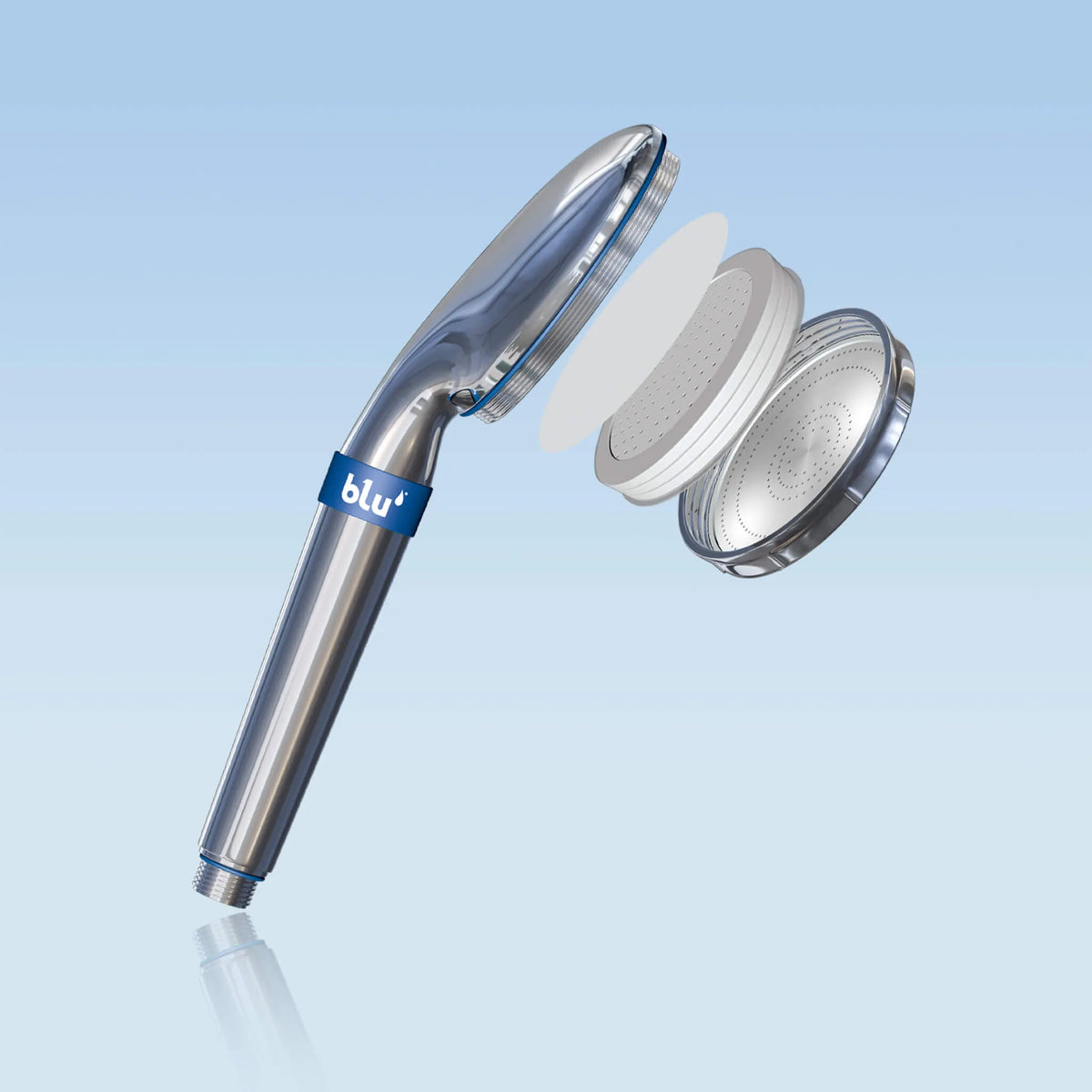
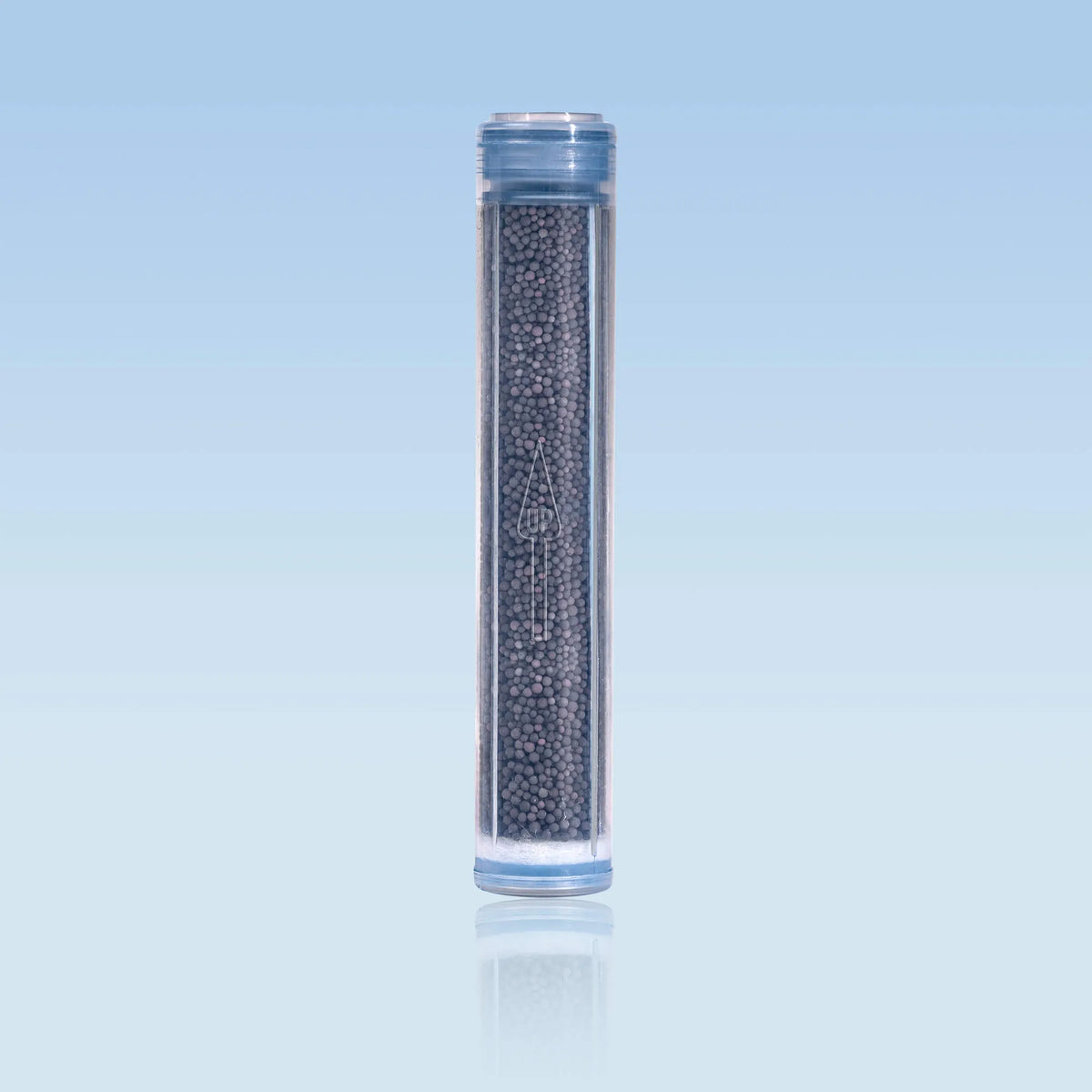
blu's Ionic Shower Head & Filter is built on an NSF/ANSI 42 certified filtration medium — NSF's public listings show the NMC media certified as components under that standard, which covers chlorine, taste, odour and particulate. It reduces chlorine, heavy metal ions, dirt and odours; its chlorine reduction has been tested by an independent laboratory (Eurofins report EFSN24031276, April 2024). In blu's voluntary, incentivized in-house survey of 2,380 verified customers in May and July 2026, 64% self-reported a hair, skin, dryness, freshness or vitality benefit.
Now the limits, which matter more. A shower filter is not a dandruff treatment: it does not act on Malassezia, does not reduce inflammation, and is not a medical device. Nor does it soften water — calcium and magnesium pass straight through, because softening needs ion-exchange resin. Use it alongside a medicated shampoo. If it's the hardness minerals themselves you want reduced, that's what blu's NXT LVL Shower Softener & Filter is for: it threads on ahead of your filter and runs the water through Seplite® ion-exchange resin. Test data on The Science, survey method on Results.
When to see a dermatologist
Self-care handles most dandruff. See a doctor when it does not — sooner if any of these appear alongside the flaking:
- Bald patches, especially ones that appeared suddenly
- Pain, burning or marked scalp tenderness
- Pustules, crusting or redness around the follicles
- Smooth, shiny areas where follicle openings seem to have gone
- Heavy shedding continuing more than a few months
- Flaking that does not improve after several weeks of correct medicated-shampoo use
Those can point to conditions needing specific treatment, including scarring hair loss where treating early changes the outcome. Nothing here substitutes for that assessment.
Frequently asked questions
Does dandruff cause permanent hair loss?
No. Dandruff does not destroy follicles. Cleveland Clinic describes the shedding that comes from scratching affected areas as explicitly not permanent hair loss.
Will treating my dandruff stop my hair fall?
It should help the share driven by scratching and breakage. It will not affect genetic or hormonal hair loss. If shedding continues once your scalp has calmed down, see a dermatologist rather than buy another shampoo.
Can hard or chlorinated water cause dandruff?
No. Dandruff is driven by Malassezia yeast, sebum and individual susceptibility. Chlorinated water can dry the scalp and make irritation more likely — a contributing factor, not a cause.
Will a shower filter clear up my dandruff?
No, and any product claiming it will is overselling. A filter reduces chlorine and heavy metal ions in your water. It does nothing to the yeast or the inflammation behind dandruff. Pair it with a medicated shampoo; do not substitute it for one.
Should I wash my hair less often if I have dandruff?
Usually the opposite. Regular washing with a medicated shampoo keeps yeast and oil in check; washing less lets scale build up.
How long before I know something is working?
Give a medicated shampoo several weeks of correct use, full contact time included, before judging it. Filtered water is felt immediately — but that is a sensation, not a clinical result.
Sources
- Causes, symptoms and the "not permanent hair loss" wording — Cleveland Clinic, Seborrheic Dermatitis
- Shampoo ingredients, contact time, frequency by hair type — AAD, Seborrheic dermatitis: diagnosis and treatment
- Prevalence and scalp microbiome — Grimshaw et al., PLOS ONE, 2019
- Telogen effluvium triggers and latency — StatPearls, Telogen Effluvium
- DHT, follicular miniaturisation, prevalence — StatPearls, Androgenetic Alopecia
- Residual chlorine and the stratum corneum — Seki T et al., J Dermatol, 2003
- Hard water and hair strength, both findings — Luqman et al., 2018 and Srinivasan et al., 2013, Int J Trichology
- Shower length and temperature — AAD, tips for relieving dry skin
- NSF/ANSI 42 component certification of the NMC media — NSF Official Listings; blu survey figures — bludubai.com/pages/results, retrieved September 2026.
- Independent chlorine-reduction test of the handheld NMC filter — Eurofins report EFSN24031276, 3 April 2024




Leave a comment