


Is Filtered Water Good for Hair? Myth vs Reality
Filtered shower water reduces chlorine and metal traces that damage hair daily. What that fixes, what it cannot, and why no shower filter softens water.

Woman holding the blu Ionic Shower Filter handheld in Matte Champagne
Yes, filtered shower water is good for hair — but not for the reasons most product pages give. A shower filter does not thicken hair, regrow it, or stop it falling out. What it does is reduce the chlorine and dissolved metal traces that meet your hair every single day. That is a real benefit, and a narrow one.
Here is the honest version: what the research shows, where it is genuinely mixed, what a filter cannot do at all, and how to tell breakage from shedding.
- Yes, with a specific mechanism. Filtering reduces chlorine, an oxidising agent that roughens the cuticle, plus the metal traces water picks up on its way to your shower head.
- No shower filter softens water. Carbon and NMC media do not reduce calcium or magnesium. Water can feel softer without being chemically softened; only ion exchange changes hardness.
- It will not stop hair loss. Shedding is a follicle process driven by genetics, hormones, illness and nutrition. Water acts on the strand, not the root.
- The hard-water evidence is mixed. One study found hard water measurably weakened hair; an earlier one found no difference in tensile strength at all.
- Read the standard, not the adjective. blu's cartridge is built on an NSF/ANSI 42 certified filtration medium — the standard covering chlorine, chloramine, taste and odour.
The short answer
Filtered water helps hair by taking away a daily stressor, not by adding a benefit. Chlorine is an oxidising agent, and hair is keratin — held together partly by sulphur-containing bonds that oxidising agents attack well. Reduce the chlorine and dissolved metals reaching your hair each morning and you take one repeated source of damage out of a routine that already involves brushing, tying, heat and sun.
What it cannot do is change your hair's growth cycle, alter your hormones, or make hard water soft.
What is actually in your shower water
Three separate things arrive out of one shower head, and a filter addresses only two of them.
Chlorine is left in the supply deliberately, so water stays microbiologically safe across kilometres of pipework. The World Health Organization notes it is present in most disinfected drinking water at 0.2–1 mg/L, against a guideline value of 5 mg/L. That residual is why UAE tap water is safe to drink, and it is also what your hair meets daily.
Hardness minerals are in it by design: UAE supply is desalinated and then re-mineralised. Calcium and magnesium are what make lather poor and leave film on hair and shower glass.
Whatever the pipes contributed. Water crosses long, hot distribution lines and often a rooftop tank, picking up rust, sediment and metal traces on the way. blu's own laboratory characterisation of a Dubai Marina sample measured 2.8 mg/L free chlorine and 18 µg/L lead before filtration — blu's figures, from one characterised sample rather than a survey of the emirate.
What the research actually shows
The evidence is real, but smaller and messier than most articles admit — so here it is with the disagreements left in.
Hard water and the hair fibre
Two studies asked the same question and disagreed. In 2013, researchers at PSG Institute of Medical Sciences soaked hair in hard water (212.5 ppm CaCO₃) and in distilled water for 30 days, then tested it: no statistically significant difference in tensile strength or elasticity, and a stated conclusion that hardness does not interfere with either. A 2018 study in the International Journal of Trichology ran a larger version and found the opposite — mean tensile strength fell from 255.49 in controls to 234.16 (P = 0.001) — concluding hard water decreases hair strength and increases breakage.
What both agree on is deposition. A 2016 scanning electron microscopy study found hard-water-treated hair carried far more calcium (0.804% versus 0.26%) and magnesium (0.34% versus 0.078%) and had a visibly ruffled surface. Rough, mineral-coated hair tangles more — and tangles get pulled.
Chlorine and the cuticle
The clearest real-world evidence comes from swimmers. A study of 67 elite Japanese swimmers and 54 matched controls found hair discolouration in 61% of the swimmers and none of the controls, with electron microscopy showing the cuticle gone entirely in the discoloured hair. Pool water is a far heavier dose than a shower, but the mechanism is the same. NSF, which runs the shower-filter standard, states plainly that chlorine released in warm shower water can dry skin and leave hair "dull, brittle, and prone to breakage".
One caveat, because the most-cited skin study here is routinely over-read: when researchers at Sheffield and King's College London washed 80 participants in water of varying hardness and chlorine levels, hard water significantly increased irritating surfactant deposits — but the paper states that "a clear effect of chlorine was not observed".
Filter, softener or neither
Most of the confusion here comes from treating "filter" and "softener" as the same product. They are not, and neither fixes everything.
| What is in the water | What it does to hair | Shower filter | Plumbed-in softener |
|---|---|---|---|
| Free chlorine and chloramine | Oxidises keratin, roughens the cuticle, strips oils | Reduces it | No effect |
| Metal traces from pipework | Deposit on the fibre; copper drives green tinting in blonde hair | Reduces them | Partial, via ion exchange |
| Calcium and magnesium | Mineral deposit, ruffled surface, poor lather, more product used | No effect | Takes them out |
| Rust and sediment | Grit and discolouration | Reduces them | No effect |
| Heat, UV, brushing, tying | The largest everyday source of breakage | No effect | No effect |
A filter at the shower head is the cheapest, most renter-friendly option and covers the top two rows. Nothing covers the last row except changing what you do. And filtered water often feels softer — blu's spray plate is perforated at 0.3 mm rather than the usual 0.9 mm, so the stream is finer, and less chlorine makes water feel less harsh. That is a change in how the shower feels, not in hardness.
Breakage is not shedding
Filtered water can reduce breakage and does nothing for shedding — and the two look identical in the drain, which is where most of the disappointment in this category comes from.
Shedding is the whole hair leaving the follicle, root and all. The American Academy of Dermatology puts normal shedding at 50 to 100 hairs a day, and excess shedding — telogen effluvium — usually traces to a trigger such as childbirth, weight loss, high fever, surgery or stress. Water quality is not on that list. Breakage is different: the fibre snapping partway along, leaving short broken ends rather than a white bulb. That is a materials problem, and it is where water chemistry, heat, friction and tension act.
If your shedding is sudden or heavy, has continued for months, or comes with visible scalp at the parting, see a doctor. A shower filter is not a treatment for hair loss of any kind.
Coloured, curly and swim-damaged hair
Colour-treated hair tends to notice first, because processing has already lifted the cuticle and oxidation works fastest where the protective layer is compromised. Take chlorine out of the daily wash and colour has a better chance of lasting between appointments — though sun, heat tools and shampoo choice all still apply. Curly and textured hair is in a similar position for a different reason: the cuticle along a curved fibre lies less flat to begin with, so mineral roughness plus Gulf humidity means more tangling and more mechanical stress per wash.
And if your blonde has gone green after a summer of swimming, chlorine is the accomplice rather than the culprit: the green comes from copper, which chlorine oxidises into compounds that bind to keratin in the cuticle.
How to read a shower filter's claims
Read the standard, not the adjective. There are no federal regulations governing residential shower filters in the US, which is why independent certification carries the weight — and why "tested to" and "certified" are not the same word.
NSF/ANSI 177 is the shower-specific standard, titled "Shower Filtration Systems, Aesthetic Effects". It covers materials safety, durability and verified reduction of aesthetic free available chlorine — that is its entire scope. NSF/ANSI 42 is the broader drinking-water aesthetic-effects standard, covering chlorine, chloramine, taste, odour, particulate, iron, manganese and zinc.
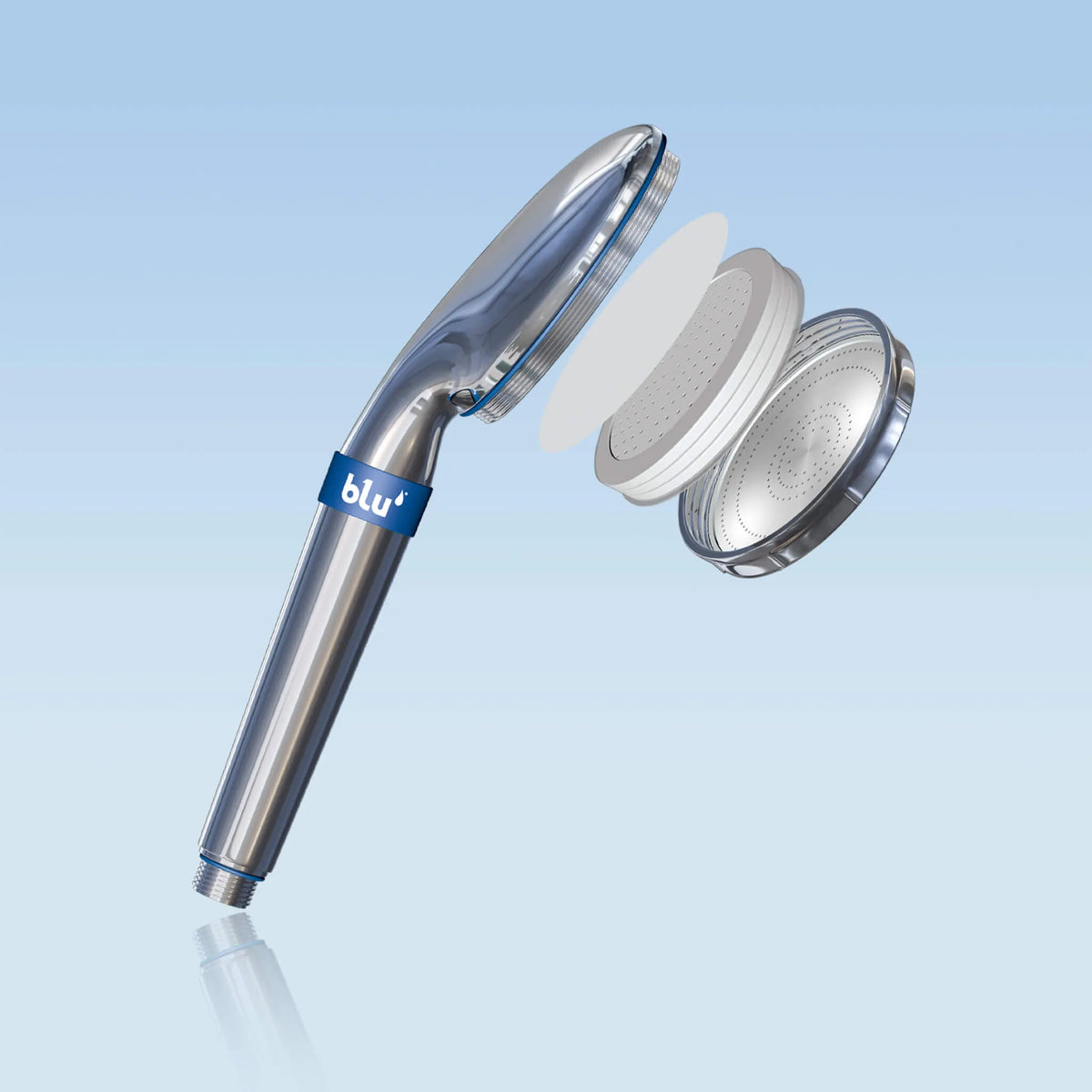
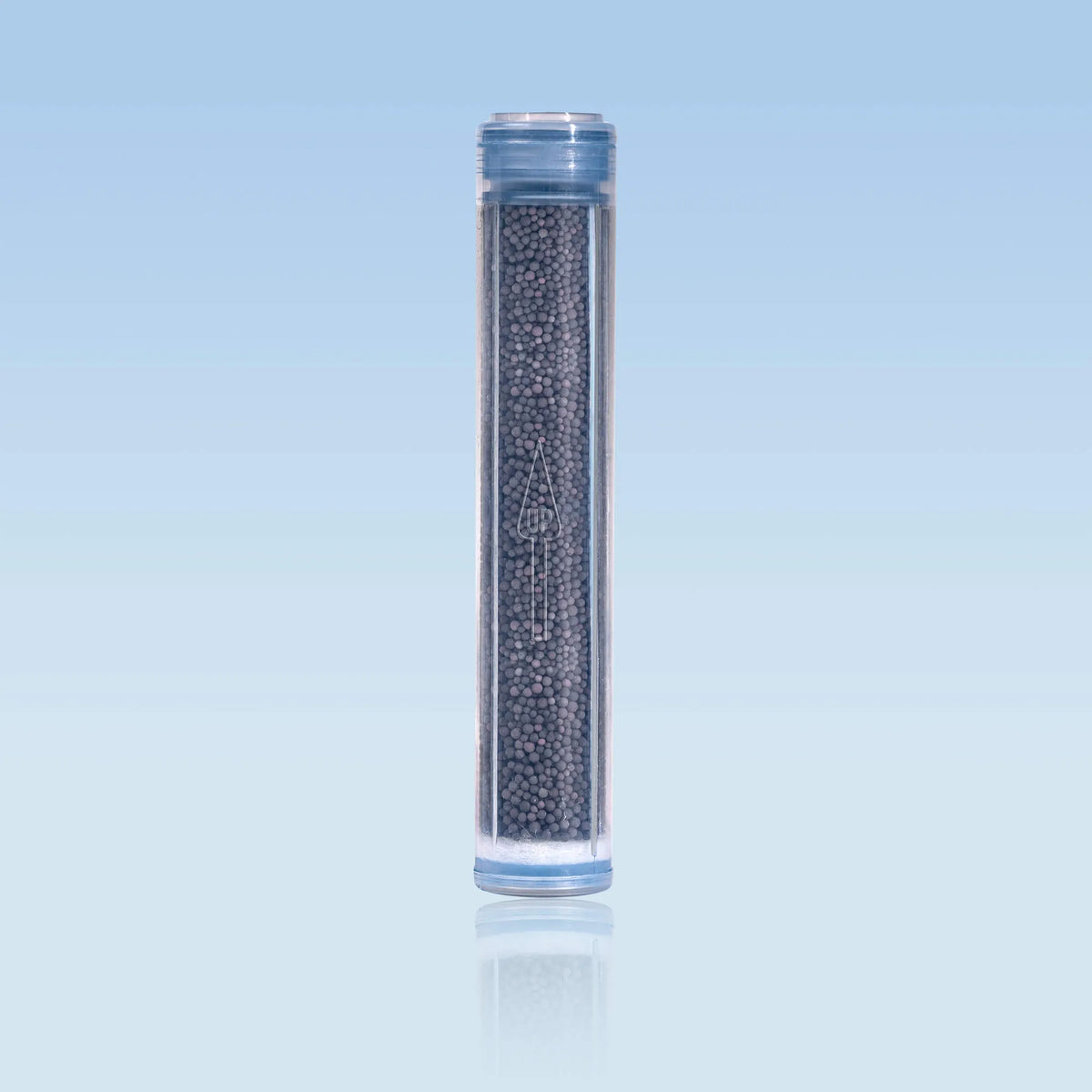
blu's Ionic Shower Head & Filter is built on an NSF/ANSI 42 certified filtration medium. That certifies the Nano Molecular Cluster medium itself, not the finished product or the company — a distinction worth knowing, because plenty of brands blur it. The cartridge reduces chlorine, heavy metal ions, dirt and odours; it does not eliminate them, and it does not touch hardness. blu also publishes independent Eurofins test results for the cartridge (free chlorine 17.09 to 0.09 mg/L, a 99.5% reduction), and the filter was named Best Overall in Gulf News' March 2024 UAE shower-filter roundup. The medium is explained on The Science page.
As for what customers report: in a voluntary, incentivized in-house survey of 2,380 verified blu customers run in May and July 2026, 64% self-reported a hair, skin or wellness benefit and 89% reported at least one positive change. Those are perceptions, not clinical measurements — the full method is on the Results page.
Frequently asked questions
Is filtered water good for hair?
Yes, for one specific reason: it reduces the chlorine and metal traces that oxidise and deposit on the fibre daily, which can mean less breakage and slower colour fade. It does not regrow hair, thicken it, or soften water.
Does a shower filter soften hard water?
No, and no shower filter does. Softening means taking calcium and magnesium out by ion exchange, a different mechanism. blu's Ionic Shower Head & Filter is a filter. If it's the hardness minerals themselves you want reduced, that's what blu's NXT LVL Shower Softener & Filter is for: it threads on ahead of your filter and runs the water through Seplite® ion-exchange resin. Water can feel softer without being softer.
Will filtered water stop my hair falling out?
No. It cannot do that, and any product claiming otherwise is overpromising. Shedding is a follicle process driven by genetics, hormones, illness, stress and nutrition; a filter acts on the strand. If your hair fall is heavy or persistent, see a doctor rather than buying a shower head.
How long before I notice a difference?
Most people notice the water feels gentler almost immediately, because the spray and the chlorine smell change straight away. Hair condition takes longer, since damaged hair grows out rather than repairs. Results vary with your water, your hair and your routine.
Does it help if I swim?
Only indirectly — a filter at home does nothing about the pool. Wet your hair with clean water before you get in so it absorbs less pool water, then rinse thoroughly afterwards with a gentle cleanser. Filtering just means the rinse is not adding chlorine back.
Sources
- World Health Organization, Chlorine in Drinking-water chemical fact sheet (residual 0.2–1 mg/L; guideline value 5 mg/L) — who.int
- Srinivasan G, Srinivas CR, Mathew AC, Duraiswami D. "Effects of hard water on hair." International Journal of Trichology 2013;5(3):137–9 — found no significant effect on tensile strength or elasticity — PubMed 24574692
- Luqman MW, Ramzan MH, Javaid U, et al. "To Evaluate and Compare Changes in Baseline Strength of Hairs after Treating them with Deionized Water and Hard Water." International Journal of Trichology 2018;10(3):113–7 — PubMed 30034190
- Srinivasan G, Chakravarthy Rangachari S. "Scanning electron microscopy of hair treated in hard water." International Journal of Dermatology 2016;55(6):e344–6 — PubMed 26711619
- Nanko H, Mutoh Y, Atsumi R, et al. "Hair-discoloration of Japanese elite swimmers." Journal of Dermatology 2000;27(10):625–34 — PubMed 11092265
- Danby SG, Brown K, Wigley AM, et al. "The Effect of Water Hardness on Surfactant Deposition after Washing and Subsequent Skin Irritation in Atopic Dermatitis Patients and Healthy Control Subjects." Journal of Investigative Dermatology 2018;138(1):68–77 — PubMed 28927888
- American Academy of Dermatology, "Hair shedding vs. hair loss" — aad.org
- NSF, "NSF/ANSI 177 – Shower Filter Certification" — nsf.org
- NSF knowledge library, "Filtration Systems Standards" (scope of NSF/ANSI 42) — nsf.org
- The Conversation, "Why does my hair turn green from the swimming pool?" — theconversation.com
- Cleveland Clinic newsroom, "Does pool water affect your skin and hair?" — clevelandclinic.org
- Eurofins, test report EFSN24031276 — free chlorine reduction, blu NMC handheld cartridge (3 April 2024) — Eurofins report PDF
- blu, Results and The Science — survey figures, methodology and laboratory characterisation, retrieved 1 September 2026.
This article is general information about water and hair, not medical advice. If you are losing hair, or your scalp is painful, inflamed or not settling, see a doctor or dermatologist.




Leave a comment