


What Is TDS in Water — and Does It Matter in Dubai?
TDS means Total Dissolved Solids. What the number really tells you about Dubai tap water, what it misses entirely, and why no shower filter — including ours — reduces it.

Woman catching shower water in her cupped palms
TDS stands for Total Dissolved Solids: the combined weight of everything dissolved in your water that isn't water. Minerals, salts, bicarbonates and traces of metals, added up and expressed in milligrams per litre (mg/L), or the equivalent parts per million.
That is the whole definition. This guide covers what the number is worth, what it completely misses, and why no shower filter — including ours — will lower it.
- The WHO sets no health-based limit for TDS. It rates the figure on taste alone: excellent below 300 mg/L, good from 300 to 600.
- A TDS meter counts ions but cannot identify them. Harmless calcium and something you would rather avoid move the reading identically.
- It misses everything that matters in a shower. Chlorine sits well under 1 mg/L; heavy metals are measured in micrograms, a thousandth of TDS's unit.
- No shower filter meaningfully reduces TDS. That takes reverse osmosis. Anyone selling one on TDS reduction is describing a different product.
- Low TDS is not automatically better. Very low-TDS water tastes flat and corrodes plumbing, which is why desalinated water is remineralised.
Where TDS comes from
Dissolved solids enter water at every stage of its journey, and a TDS reading summarises that entire history in one number.
The WHO lists the principal constituents as calcium, magnesium, sodium and potassium, plus carbonate, hydrogencarbonate, chloride, sulfate and nitrate. Some are natural. Some are added deliberately: desalinated seawater leaves the plant almost completely stripped, so it is remineralised before distribution — partly for taste, partly because water that pure is corrosive to pipes. And some are picked up afterwards, from the network, a building's plumbing and its tank.
Compressing all of that into a single figure is where its limitation begins.
How TDS is measured, and why that matters
The laboratory method evaporates a sample and weighs what is left. The handheld meters people buy do something quicker and less specific. As the WHO describes it, the most common method measures specific conductivity with a probe that detects ions, then converts that reading to a TDS value using a factor that varies with the type of water.
That shortcut matters more than anything else on this page. A conductivity meter responds to dissolved ions, and to all of them the same way. It counts; it cannot identify. Calcium that is good for you and lead that is not push the needle in the same direction, and neither arrives labelled.
What counts as a normal TDS reading
There are two reference points worth knowing, and only one of them is about health — because the health one does not exist.
The World Health Organization has not proposed any health-based guideline value for TDS at all. Its background document rates the figure purely on taste, using panels of tasters:
| TDS level | WHO palatability rating |
|---|---|
| Less than 300 mg/L | Excellent |
| 300 to 600 mg/L | Good |
| 600 to 900 mg/L | Fair |
| 900 to 1,200 mg/L | Poor |
| Above 1,200 mg/L | Unacceptable |
Read that twice, because it undoes most of what gets said about TDS online. The WHO treats TDS as a taste parameter, not a health one. It notes separately that levels above 500 mg/L cause excessive scaling in pipes, heaters and appliances — a plumbing consideration, not a medical one.
The regional reference is GSO 149, the Gulf Standard for unbottled drinking water, which requires dissolved solids to "range between 100 and 1000 ppm". Note the lower bound: the standard sets a floor as well as a ceiling.
If you own a meter, judge your reading against those two scales rather than something you read on a forum — and expect it to differ from your neighbour's.
What a TDS reading cannot tell you
Everything that actually affects your hair and skin in a shower. This is where most TDS content goes wrong.
It cannot tell good minerals from bad ones
A reading of 200 mg/L that is mostly calcium and magnesium and a reading of 200 mg/L carrying something you would rather avoid look identical on the display. The meter gives you a total, not an ingredient list. Only a laboratory analysis tells you composition.
It misses contaminants present in tiny quantities
This is the crucial one. The things that affect a shower are present at concentrations far too small to move a TDS reading. A chlorine residual is maintained across the network deliberately, so the water stays microbiologically safe, at well under a milligram per litre. Heavy metals are measured in micrograms per litre — a thousandth of the unit TDS is reported in. A lead concentration high enough to be a genuine concern would shift a 200 mg/L reading by a fraction of a single point. Invisible.
And those trace contaminants are real and local. A 2018 study in Water assessed 30 houses in an Abu Dhabi district over a year, sampling at the water main, the household tank and the kitchen and bathroom taps. It found arsenic, cadmium and lead above the maximum levels set in UAE standards in many of them, and characterised the contamination as household-specific rather than uniform across the district — roughly 30% of houses at high risk, 55% moderate, 15% low. Two flats on the same street can differ. A TDS meter would have flagged none of it.
It says nothing about anything that doesn't conduct
Bacteria, sediment and many organic compounds are not dissolved ions, so they barely register.
Four TDS myths, handled honestly
Myth 1: high TDS is always bad for you
No. TDS is a mixture, and much of it is calcium and magnesium. The WHO's decision not to set a health-based limit reflects exactly this. What matters is which solids, not how many.
Myth 2: the lower the TDS, the better
Also no. The WHO notes that water with extremely low TDS is unacceptable to consumers for its flat, insipid taste, and is often corrosive to water-supply systems. That is precisely why desalinated water is remineralised before it is sent out. Chasing a low number is not a health strategy.
Myth 3: TDS is why your shampoo won't lather
Half true, and worth being precise about. Poor lather is caused by hardness specifically — the calcium and magnesium — which react with the surfactants in soap and shampoo. Hardness contributes to TDS but is not the same thing. A high-TDS water low in calcium would lather fine.
Myth 4: a shower filter will lower your TDS
It will not, and we would rather say so plainly than sell you something on a false premise. No shower filter meaningfully reduces TDS — including ours. Reducing dissolved minerals at that scale takes reverse osmosis, not a cartridge in a shower head.
One wrinkle worth knowing, because it gets misused in marketing: TDS is one of the claim categories available under NSF/ANSI 42, the drinking-water standard for aesthetic effects — but certified claims vary by product, and holding that certification does not mean a product reduces TDS. blu makes no TDS-reduction claim, and be sceptical of any shower filter that does.
What to act on instead
The two things a TDS meter cannot see: the residual chlorine that comes with safely disinfected water, and the metals and rust picked up between the plant and your tap. Those are what strip natural oils, roughen the hair cuticle and leave skin feeling tight — the mechanism we set out in why Dubai's water is so hard on your hair and skin.
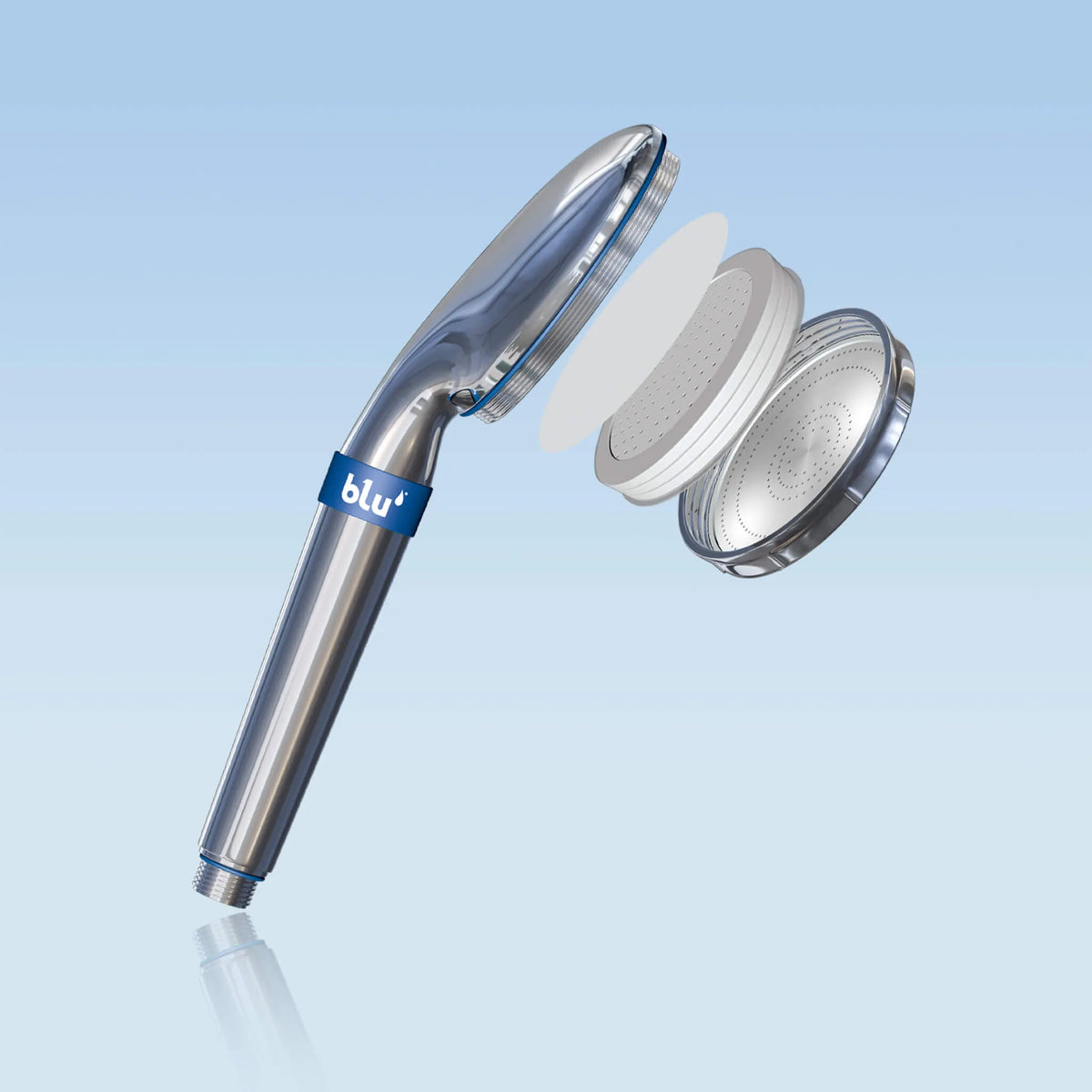
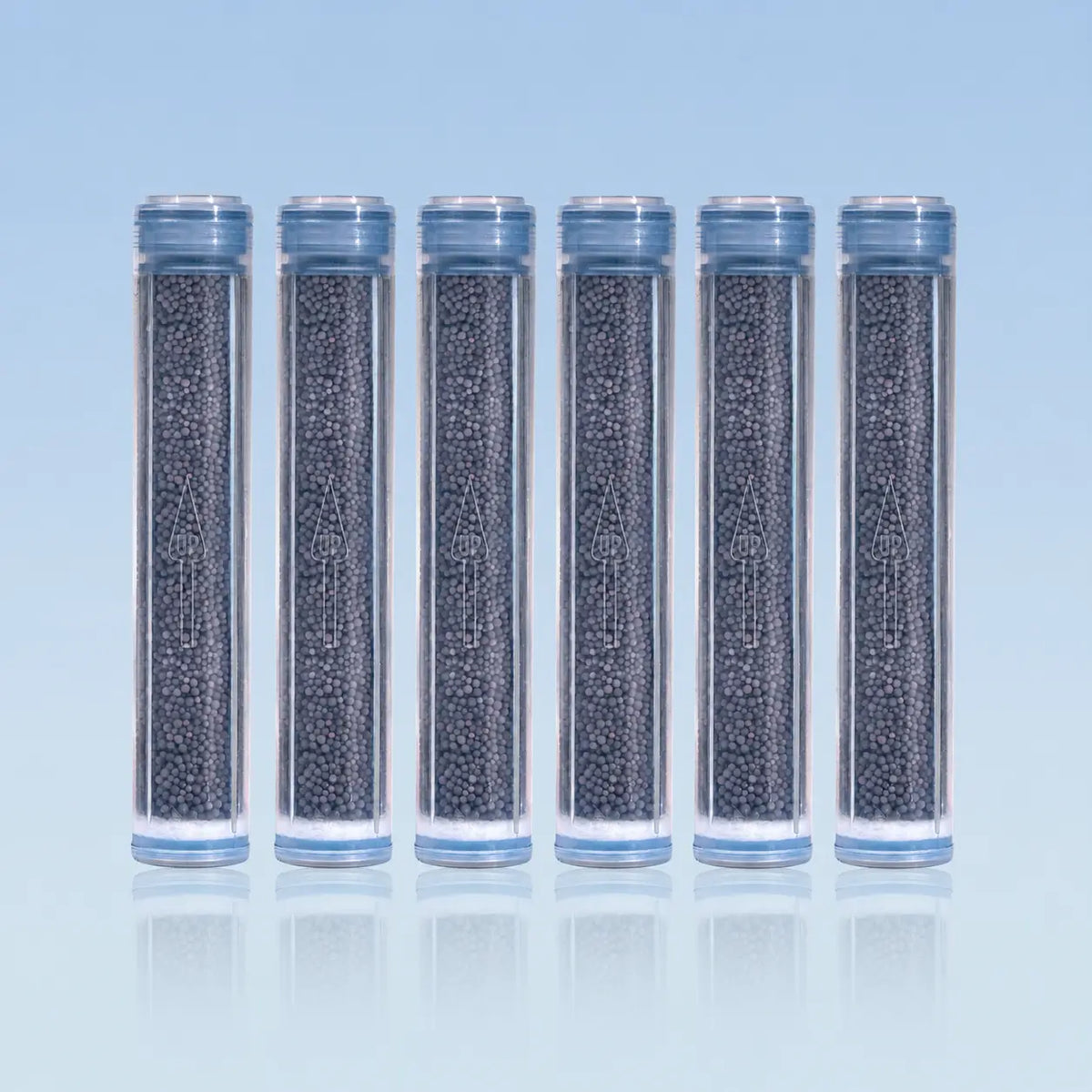
That is also the honest scope of what blu's Ionic Shower Head with Built-in Shower Filter does. Its NMC medium is an NSF/ANSI 42 component-certified filtration medium; it reduces chlorine, dirt and odours and is designed to reduce heavy-metal ions. Eurofins testing of the NMC cartridge measured free residual chlorine falling from 17.09 mg/L to 0.09 mg/L, a 99.5% reduction. How the medium works is on The Science.
What it does not do: reduce TDS, or soften water. The blu Ionic is a filter, not a softener. Carbon and NMC media do not reduce hardness, so calcium and magnesium pass through untouched — softening requires ion-exchange resin in a dedicated unit. Water can feel gentler once chlorine is reduced without having been chemically softened; those are two different claims. If hardness is your real target, that is a shower filter versus water softener question. If it's the hardness minerals themselves you want reduced, that's what blu's NXT LVL Shower Softener & Filter is for: it threads on ahead of your filter and runs the water through Seplite® ion-exchange resin.
Frequently asked questions
What is a good TDS level for drinking water?
The WHO sets no health-based limit and rates TDS on taste alone: below 300 mg/L is "excellent", 300 to 600 "good". GSO 149, the Gulf Standard for unbottled drinking water, requires dissolved solids to fall between 100 and 1,000 ppm — a floor as well as a ceiling.
Does a shower filter reduce TDS?
No. No shower filter — blu's included — meaningfully reduces dissolved minerals. That needs reverse osmosis. A shower filter targets chlorine and other water pollutants instead, which is a different job entirely.
Is high TDS bad for hair and skin?
Not TDS as such. The component that can affect hair and skin is hardness — calcium and magnesium — which deposits on hair and interferes with how cleansers rinse. TDS includes hardness but also plenty that is irrelevant to your hair, which is why the total is a poor proxy.
Should I buy a TDS meter for my flat?
It is a fine curiosity and a reasonable way to spot a sudden change in your supply, but do not treat the number as a verdict on water quality. It cannot see chlorine, trace metals or bacteria, and it cannot distinguish helpful minerals from harmful ones.
Why does my reading differ from my neighbour's?
The distributed water is the same; buildings are not. Pipe age and material, and how long water sits in a rooftop tank in the heat, change what arrives at your tap. That is the same reason the Abu Dhabi study above found contamination to be household-specific rather than area-wide.
Sources
- No health-based guideline value for TDS; palatability ratings; conductivity measurement method; scaling above 500 mg/L; low-TDS water corrosive and flat-tasting — WHO, Total dissolved solids in drinking-water (background document for the WHO Guidelines)
- Dissolved solids "shall range between 100 and 1000 ppm" — GSO 149, Gulf Standard for unbottled drinking water (WTO TBT notification)
- Arsenic, cadmium and lead above UAE maximum levels; water main highest; contamination household-specific — "Health Risk Assessment of Household Drinking Water in a District in the UAE", Water 2018, 10(12), 1726
- Scope of NSF/ANSI 42 and its claim categories — NSF, standards for water treatment systems
- NMC medium and certification — blu, The Science
- Free residual chlorine 17.09 mg/L to 0.09 mg/L (99.5% reduction) on the NMC cartridge — Eurofins test report EFSN24031276, 2024-04-03


Leave a comment